
Does this sound familiar? You went to bed tired and fell asleep without much trouble. And then, for no apparent reason, your eyes open. The room is dark, everything is quiet, and for a few seconds you don't know what time it is. Then you make the mistake of looking at the clock. 3:07 a.m.
So maybe you roll over and close your eyes, fully expecting to fall back asleep. Instead, your brain seems to think it has been given an unexpected go-ahead. You remember the email you forgot to answer. You start planning tomorrow's meals. You wonder whether you're too hot or if you have to pee. Then comes the thought that really wakes you up: I have to be up in three hours, and if I don't fall asleep soon, tomorrow is going to be a nightmare.
Welcome to the 3 A.M. Wake-Up Club, one of those clubs nobody remembers joining but an awful lot of women seem to belong to somewhere around midlife. Those days when you could put your head on the pillow and sleep straight through until morning are now a dim memory. Some nights are fine. Other nights, you're wide awake at an hour when you have absolutely no desire to be.
There's no shortage of advice about why we wake up during the night. Hormonal changes, stress, caffeine, alcohol, and the natural changes in sleep as we get older can all play a part. You've probably heard plenty about keeping your bedroom cool, avoiding screens before bed, and establishing a regular sleep schedule. That's all well and good, but none of it is especially helpful when you're lying there at 3 a.m. wondering what to do next.

And that's what I want to talk about. Not how to prevent every nighttime awakening, but what you can do when you find yourself awake and sleep doesn't seem interested in coming back. Because being awake in the middle of the night can take several forms, and what helps when your mind is racing may not be what you need when your body simply won't settle down.
My Mind Just Won't Slow Down
Isn't it remarkable how much thinking we can accomplish in the middle of the night? During the day, you might have trouble remembering why you walked into the kitchen, but at 3 a.m. your mind can recall every unfinished task, awkward conversation, and appointment you need to schedule over the next six months. And the more you tell yourself to stop thinking and go back to sleep, the more your brain seems determined to keep the conversation going.
Trying to empty your mind can be a frustrating exercise. After all, if you're concentrating on not thinking, you're still thinking! Sometimes it's easier to give your mind something harmless to occupy itself with, something that doesn't involve making decisions, solving problems, or reliving yesterday's mistakes. You're not trying to shut down your thoughts so much as giving them somewhere else to go.
Give Your Mind Something Else to Do
The Cognitive Shuffle
Forget counting sheep. Let's put them to work instead! The cognitive shuffle is a way of gently occupying your mind with a series of unrelated images rather than following a train of thoughts that keeps you awake. By giving your brain something to focus on that doesn't involve planning, worrying, or solving problems, you may find it easier to drift off.
Start with the word SHEEP. Beginning with S, bring to mind unrelated objects that start with that letter: suitcase, strawberry, sailboat. Picture each object for a few seconds before moving on to another. Then try H for hammer, hammock, or hat. Continue through the remaining letters, letting the images appear and disappear without connecting them into a story. There's nothing to remember or figure out, just a collection of unrelated images passing through your mind.
Familiar Place Visualization
Picture somewhere you know well and find peaceful or relaxing, perhaps a favorite walking trail, the house where you grew up, or a quiet place you've visited many times. Slowly make your way through it in your imagination, noticing the details. What does the path look like? Where's the furniture? What's growing in the garden? What can you see through the windows? Choose somewhere that brings a sense of comfort rather than excitement, and take your time exploring without worrying about where you're going next.

Both techniques give your mind something to do without asking it to accomplish anything. And there's no need to finish what you've started. If you drift off somewhere between the hammock and the hat, or halfway down that imaginary walking trail, so much the better.
I Can't Stop Worrying About Tomorrow
Sometimes the problem isn't random thoughts popping into your head. There's something genuinely bothering you, and the middle of the night seems to give it center stage. Maybe you're concerned about a family member, replaying an uncomfortable conversation, or trying to figure out how you're going to fit everything into tomorrow. Whatever it is, the problem seems much more important at three in the morning than it did at three in the afternoon.
The trouble with trying to solve these things in the middle of the night is that there's usually very little you can do about them. You can rehearse tomorrow's conversation a dozen times, but the other person isn't there to participate. You can work through your schedule over and over, but you still have to wait until morning to do anything about it. Meanwhile, the more involved you become in trying to find a solution, the farther away sleep seems to get.
Put Tomorrow on Hold Until Morning
The Bedside Notepad
Keep a small notepad and pencil beside your bed. If there's something you need to remember, write down just enough to remind yourself in the morning. Call the insurance company. Pick up the prescription. Talk to Susan. You're not making a full to-do list or working through the problem. You're simply putting it somewhere you won't forget it. Once it's on paper, leave it there until tomorrow.
And if you find yourself waking up with the same unfinished business on your mind night after night, try taking five minutes before bed to write down whatever's been occupying your thoughts. Getting tomorrow's reminders and concerns onto paper before you turn out the light may mean there's less for your mind to revisit at 3 a.m.
Postponing Worry
If you're worrying about something that doesn't have an immediate solution, acknowledge that it's important without trying to resolve it tonight. You might tell yourself, This matters, but I don't need to figure it out right now. Give yourself a specific opportunity to return to it tomorrow, perhaps while having your morning coffee or taking a walk. For now, there's nothing more that needs doing.

The important distinction is between caring about something and needing to do something about it right now. You don't have to stop caring about the people and situations in your life just because it's bedtime. But you can give yourself permission to set those concerns aside for a few hours. They'll still be there in the morning if they need your attention.
I'm Exhausted, but I'm Wide Awake
This is one of the more annoying versions of the 3 A.M. Wake-Up Club. You were practically falling asleep on the couch earlier in the evening, and now that you're supposed to be sleeping, you feel as though you could get up and start the day. How is it possible to be so tired and yet so completely awake?
There's a difference between feeling tired and feeling sleepy. Tiredness is that worn-out, low-energy feeling when you'd like nothing better than to rest. Sleepiness is when your eyelids start getting heavy, your attention drifts, and you have trouble staying awake. You can be exhausted without feeling sleepy, and lying in bed trying to force yourself to sleep when you're wide awake usually doesn't accomplish much beyond making you irritated.
If you're comfortable and beginning to drift, stay where you are. But if you're tossing and turning, getting frustrated, or becoming more alert as the minutes pass, a change of scenery may be just what you need.
Take a Quiet Break From Trying to Sleep
The Quiet Reset
Get out of bed and find a comfortable spot where you can relax without turning on bright lights. Read a few pages of a familiar book, listen to gentle music or an audiobook you've heard before, or work on a simple knitting project. Choose something enjoyable that doesn't require much concentration. This probably isn't the time to start a gripping mystery novel, catch up on the news, or decide that the kitchen cupboards could use reorganizing.
And what about that old-fashioned remedy, a glass of warm milk? There's no guarantee it will put you to sleep, but that doesn't mean Grandma was entirely wrong. A little warm milk, perhaps with a sprinkle of cinnamon, can be a comforting way to settle down. If milk isn't your thing, a small cup of caffeine-free herbal tea may be just as pleasant. Just don't drink so much that you find yourself making another trip to the bathroom!
Return When Sleepy
Pay attention to how you're feeling rather than how much time has passed. When your eyes begin to feel heavy, you find yourself losing your place in the book, or your attention starts drifting, head back to bed. If you become wide awake and frustrated again, you can repeat the process. There's no need to follow a strict twenty-minute rule or keep checking the clock to see whether it's time to get up.

The idea behind this approach is simple. Your bed should be a place where you sleep, not a place where you spend hours becoming increasingly annoyed that you're awake. Taking a quiet break gives you a chance to settle down without turning the bedroom into the scene of an ongoing battle.
My Body Just Won't Settle Down
Sometimes your mind is reasonably quiet, but your body has other ideas. Your shoulders feel tight, your legs are restless, or you just can't seem to get comfortable. You move the pillow, adjust the blankets, turn onto your other side, and then start the whole process again. At some point, even the mattress that seemed perfectly comfortable when you went to bed begins to feel like it's conspiring against you.
Our bodies can hold more tension than we realize, particularly after a stressful or physically demanding day. A little gentle movement or relaxation may help release some of it. And sometimes we're so busy trying to fall asleep that we overlook the simple fact that we're uncomfortable.
Help Your Body Let Go of Tension
Progressive Muscle Relaxation
Starting with your feet, gently tighten the muscles for about five seconds, then release them completely for ten to fifteen seconds. Work your way up through your legs, hands, arms, shoulders, and face, noticing the difference between holding tension and letting it go. Keep the contractions gentle, and skip anything that causes pain or cramping. You may discover that you've been holding tension in places you weren't even aware of.
Extended-Exhale Breathing
Breathe in comfortably through your nose, then let your exhale last a little longer than your inhale. You might breathe in for a count of three and out for a count of five. Continue for a few comfortable breaths without holding your breath or trying to get the timing exactly right. If counting makes you more alert, forget the numbers and simply let your breathing settle into a comfortable rhythm.
Gentle Movement
If your body feels stiff or restless, get up and move around for a minute or two. Roll your shoulders, gently stretch your neck, walk around the room, or try a few familiar stretches that feel good. You're not exercising in the middle of the night; you're simply giving your body a chance to release some tension before settling back into bed.

And don't overlook the obvious. If you're too hot, throw off a blanket. If you're cold, pull on another one. If your pillow is uncomfortable, adjust it. There's no reason to put up with physical discomfort just because you're trying to fall asleep.
One thing worth mentioning, though: if you regularly experience an uncomfortable urge to move your legs that becomes worse when you're resting and improves when you move, it may be restless legs syndrome rather than ordinary restlessness. That's worth discussing with your healthcare provider.
Something Woke Me Up, and Now I Can't Get Back to Sleep
Maybe it was the dog barking, your partner snoring, a trip to the bathroom, or a hot flash that left you kicking off the covers. You were sleeping perfectly well until something interrupted you, and now you're lying there wondering why you can't simply pick up where you left off.
As we get older, sleep naturally becomes somewhat lighter and more easily disrupted. Hormonal changes during perimenopause and menopause can add to that, especially when hot flashes or night sweats enter the picture. But whatever woke you, there's no need to make more of the interruption than necessary. The first order of business is simply getting comfortable again.
Settle Back In Without Starting the Day
The Comfort Reset
Take care of whatever woke you as quietly and simply as possible. If you're overheated, cool down and adjust the bedding. If you need the bathroom, keep the lights low and return to bed without stopping to check your phone. If noise is the problem, try earplugs or a familiar background sound if those help. Once you're comfortable again, give yourself a chance to settle.
The No-Clock Rule
Turn the clock away from the bed or cover the display so you aren't tempted to check it every time you wake. Knowing that it's 2:47 instead of 3:26 doesn't help you sleep, and calculating how many hours you have left can quickly turn an ordinary awakening into a frustrating experience. If you use your phone as an alarm, leave it face down or out of easy reach.

A brief awakening doesn't mean the rest of your night is lost. We naturally move through lighter and deeper stages of sleep, and waking occasionally is part of that process. Sometimes the best response is to take care of whatever interrupted you and then leave the rest alone.
I've Tried Everything, and I'm Still Awake!
Perhaps you've already tried the cognitive shuffle, taken an imaginary walk through your favorite vacation spot, gotten up to read, and returned to bed. And here you are, still awake. At this point, you may be wondering whether there's anything left to try.
There is something rather ironic about how hard we can work at trying to sleep. We count breaths, relax muscles, picture peaceful scenes, and check periodically to see whether we're getting sleepy. Before long, getting back to sleep has become another job we're trying to accomplish, complete with a growing sense of frustration because we're not getting the results we want.
But sleep isn't something we can make happen through determination. We can make ourselves comfortable and create conditions that encourage it, but we can't force ourselves to fall asleep simply because we'd like to.
Give Yourself Permission to Stop Trying
Rest Without an Agenda
If you're comfortable lying in bed, allow yourself to rest without making sleep the immediate goal. Notice the warmth of the blankets, the support of the mattress, or the quiet of the room. You don't have to concentrate on anything in particular or check whether you're becoming sleepy. Just enjoy being comfortable for a while. And if resting turns into another frustrating attempt to sleep, there's nothing wrong with getting up for another quiet break.
Let Go of the Sleep Deadline
If you're worrying about how you'll feel tomorrow, remind yourself that tomorrow hasn't happened yet. You may be tired, or you may find that you manage better than you expected. You don't have to decide that now. Stop calculating how much sleep you've lost and give yourself a chance to enjoy whatever rest the remainder of the night brings.

There's no single technique that's going to work every time, and trying one after another can become its own source of frustration. Sometimes the most useful change is to stop treating wakefulness as something you have to defeat. You'd rather be sleeping, of course, but you don't have to spend the rest of the night fighting with yourself about it.
Give Yourself a Little Grace the Next Day
So you didn't get back to sleep, or maybe you managed another hour or two before the alarm went off. Either way, morning has arrived, and you're not feeling particularly refreshed. You might be tempted to reach for another cup of coffee and push through the day as though nothing happened. After all, there are things to do, people counting on you, and a schedule that doesn't magically disappear because you had a lousy night's sleep.
But perhaps today isn't the day to expect quite so much of yourself. When you're tired, even ordinary tasks can feel more demanding, and you may find yourself getting frustrated more easily or having trouble concentrating. There's no need to add to that by getting annoyed with yourself for being tired. You didn't choose to be awake half the night, and you certainly don't have to make up for it by being extra productive the next day.
Make Today a Little Easier on Yourself
Adjust Your Expectations
Take care of what really needs doing and give yourself permission to leave the less important things for another day. Maybe the housework can wait, dinner can be something simple, or you can take a quiet walk instead of pushing through a strenuous workout. You can still accomplish what matters without expecting yourself to operate at full speed.
Keep Some Familiar Routines
Try to get up reasonably close to your usual time, enjoy some daylight, eat regular meals, and move around a little. There's no need to abandon your entire routine because you had a difficult night. If you're exhausted, take things easier and avoid activities that would be unsafe when you're sleepy, especially driving. A short, early-afternoon nap may help if you need one, although long or late naps can make sleeping that night more difficult.
Leave Last Night Behind
You may be tempted to spend the day replaying how poorly you slept and wondering whether tonight will be just as bad. When those thoughts come up, remind yourself that one night doesn't predict the next. Focus on the day you're having rather than the night you're afraid might be coming.

And don't forget to enjoy the day where you can. A poor night's sleep doesn't mean the whole day has to be miserable. You may feel better as the morning goes on, or you may need a little more rest than usual. Either way, taking good care of yourself sometimes means recognizing that today calls for a little less doing and a little more kindness.
When It's More Than an Occasional Restless Night
Of course, there's a difference between waking occasionally and regularly spending hours struggling to sleep. If nighttime awakenings are happening frequently, leaving you exhausted during the day, or affecting your ability to function, it's worth talking with your healthcare provider.
Conditions such as sleep apnea, restless legs syndrome, chronic pain, depression, and medication effects can interfere with sleep and may need specific treatment. Loud snoring, gasping during sleep, significant daytime sleepiness, or an uncomfortable urge to move your legs at night are all reasons to seek medical advice. And if hot flashes or night sweats are regularly waking you, there are effective hormonal and nonhormonal treatment options worth discussing.
For persistent insomnia, cognitive behavioral therapy for insomnia, usually called CBT-I, is considered a first-line treatment. It goes beyond the usual sleep advice to address patterns that can keep insomnia going, and it can be very effective. The National Institutes of Health offers a helpful overview of insomnia treatments, including CBT-I. You don't have to wait until your sleep problems become unbearable before asking for help.
Keep a Little Help Close at Hand
Nobody wants to wake up at 3 a.m. and start researching ways to fall asleep. And even when you've read some helpful suggestions, remembering them in the middle of the night isn't always easy.
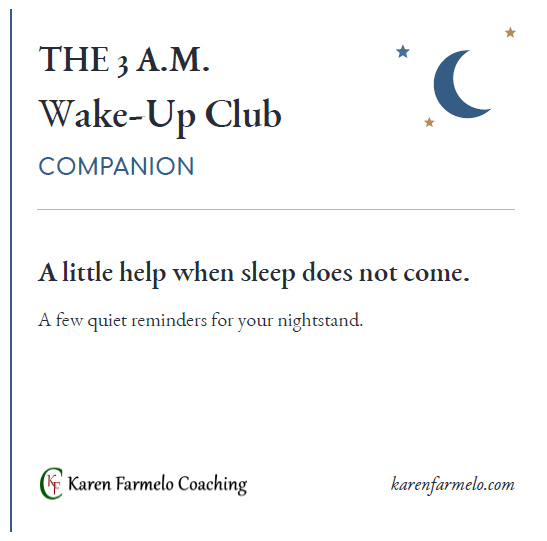
That's why I've put together The 3 A.M. Wake-Up Companion, a small, foldable guide you can print and keep on your nightstand. It includes reminders of the techniques we've talked about, without all the explanations, so you can find something useful without reaching for your phone.
The next time you find yourself awake at 3:07 a.m., you may still wish you were sound asleep. But at least you'll have a few ideas about what to do. Maybe you'll put those sheep to work, take a quiet break with a book, or simply get comfortable and see what happens.
And if none of those things brings sleep back right away, you can still make the remaining hours a little more pleasant. There's no need to try every technique or spend the night worrying about tomorrow.
You may not be able to choose when you wake up, but you don't have to spend those awake hours fighting with yourself. And perhaps the next meeting of the 3 A.M. Wake-Up Club will be a rather short one.

Let’s get cooking!
A restless night can leave you with little energy or enthusiasm for cooking the next day. That's when having a few simple, satisfying options in your kitchen can make all the difference. Keeping useful staples on hand, taking advantage of shortcuts, and knowing when to keep things easy are all ways to nourish yourself well without adding more work to an already tiring day.
Golden Milk Latte
Remember being offered a glass of warm milk when you couldn't sleep? This Golden Milk Latte takes that old-fashioned comfort and gives it a little more personality. Turmeric provides the beautiful golden color, while cinnamon, ginger, and vanilla add layers of warm, fragrant flavor. A touch of honey or maple syrup brings everything together without making it overly sweet.
This version is deliberately gentle on the spices, making it a lovely drink to enjoy in the evening. If you prefer a more assertive turmeric and ginger flavor, the recipe includes a variation for that, too. It takes just a few minutes to prepare, and there's something rather nice about warming a single serving, frothing it up, and settling into your favorite chair with a good book.
It's a lovely drink for a quiet evening, especially when you're trying to establish a more relaxing bedtime routine.

Golden Milk Latte
Ingredients
- 1 cup milk or unsweetened fortified soy milk
- ¼ tsp ground turmeric
- ⅛ tsp ground cinnamon
- ⅛ tsp ground ginger
- A small pinch of freshly ground black pepper
- ¼ tsp vanilla extract
- ½–1 tsp honey or maple syrup, to taste
Instructions
- Combine the milk, turmeric, cinnamon, ginger, and black pepper in a small saucepan. Whisk until the spices are well dispersed.
- Warm over medium-low heat, stirring occasionally, until the milk is steaming but not boiling, about 3–4 minutes.
- Remove from the heat and stir in the vanilla and honey or maple syrup. Taste and adjust the sweetness.
- For a latte-style finish, froth the warm milk with a handheld frother or whisk vigorously until lightly foamy. Pour into your favorite mug and enjoy.
Notes
- For a bolder golden milk: Increase the turmeric to ½ teaspoon, the cinnamon to ¼ teaspoon, and the ginger to ¼ teaspoon. You can also substitute a teaspoon of finely grated fresh ginger for the ground ginger. Simmer gently for a few extra minutes to allow the flavors to develop, then strain if desired.
- A little extra creaminess: Whole or 2% milk gives a richer result, while unsweetened soy milk is a good plant-based option. A small amount of fat also helps carry the spices' flavors.
Italian Sausage, White Bean, Tomato, and Kale Skillet
Italian sausage and white beans are a wonderful combination. The sausage brings savory, aromatic seasoning, while the beans offer a mild, creamy contrast that works beautifully with tomatoes and greens. This Italian Sausage, White Bean, Tomato, and Kale Skillet takes advantage of those flavors in a meal that's hearty enough to stand alone, yet simple enough to prepare on a busy weeknight.
Using Italian turkey sausage provides plenty of flavor without making the finished dish overly rich. Canned diced tomatoes create a light sauce as everything simmers together, and the kale adds a pleasantly earthy flavor and a little texture. As the beans warm, some begin to break down slightly and thicken the sauce. Finish with a sprinkle of Parmesan, and you've got a rustic, satisfying dinner that tastes like it took much longer to prepare.
The real beauty of this recipe is how little work it requires. Most of the ingredients come straight from the pantry, and using prewashed kale eliminates another preparation step. Everything cooks in a single skillet in about 25 minutes, making this an easy meal to turn to when you want something homemade without a lot of effort.
Italian Sausage, White Bean, Tomato, and Kale Skillet
Ingredients
- 1 tbsp olive oil
- 1 pound Italian turkey sausage, mild or hot, casings removed if using links
- ¾ cup diced onion
- 2 cloves garlic, minced
- 1 can (14.5 oz.) diced tomatoes, with juices
- 2 cans (15 oz. each) cannellini or Great Northern beans, drained and rinsed
- ½ cup low-sodium chicken broth or water
- 1 tsp dried Italian seasoning
- 4 cups chopped kale, tough stems removed (about 4 oz.)
- ¼ tsp crushed red pepper flakes, optional
- Salt and freshly ground black pepper, to taste
- ¼ cup freshly grated Parmesan cheese, optional
Instructions
- Heat the olive oil in a large skillet over medium heat. Add the turkey sausage and cook for 5–6 minutes, breaking it into bite-sized pieces with a wooden spoon, until browned and cooked through.
- Add the onion and cook for 3–4 minutes, stirring occasionally, until softened. Stir in the garlic and cook for another 30 seconds, just until fragrant.
- Add the diced tomatoes with their juices, white beans, broth, Italian seasoning, and crushed red pepper flakes, if using. Stir to combine, scraping up any browned bits from the bottom of the skillet.
- Bring to a gentle simmer and cook uncovered for 5–7 minutes, allowing the flavors to come together and the liquid to reduce slightly.
- Add the greens. Stir in the kale, adding it in batches if necessary. Cover and cook for 3–5 minutes, until the kale is tender. If the mixture becomes too thick, add a splash of broth or water.
- Finish and serve. Taste and adjust the salt and pepper. Sprinkle with Parmesan cheese, if desired, and serve warm.
Notes
- Make it even easier: Choose bulk Italian turkey sausage, pre-diced onion, jarred minced garlic, and a bag of prewashed, chopped kale. With those shortcuts, there's almost no prep work.
- Adjust the consistency: For a thicker, heartier skillet, mash about ½ cup of the beans with the back of your spoon as the mixture simmers. They'll naturally thicken the tomato sauce without needing flour or cream.
- Change the greens: Baby spinach works beautifully in place of kale and wilts in just a minute or two. It's a particularly good option when you want dinner on the table as quickly as possible.
- Make it a meal: This skillet is satisfying on its own, but it's also delicious with a slice of toasted whole-grain bread to soak up the tomato juices. For a heartier dinner, serve it over quick-cooking polenta or whole-grain pasta.
- Leftovers: Refrigerate in a covered container for up to 3–4 days. Reheat gently, adding a little broth or water if needed.
There you have it!
The next time you find yourself wide awake in the middle of the night, remember that there's more than one way to settle back down. Sometimes letting go of the struggle is the best place to begin. Sweet dreams!