
Onions: The Quiet Architect of Flavor
There are ingredients that arrive with drama - heirloom tomatoes in late August…fresh basil torn over warm pasta…a perfectly ripe peach, dripping down your wrist...a wedge of Parmigiano-Reggiano, crystalline and fragrant.
And then there are ingredients that arrive quietly.
The onion is one of those.
The onion does not demand attention. It sits in a mesh bag in the pantry, dry and papery, waiting. It is rarely plated whole. It is chopped before it is admired. It is sautéed before it is considered. It dissolves into soups, stews, braises, stocks, sauces, curries, casseroles, stir-fries, and roasts. It is the beginning of so many recipes that we hardly notice when we reach for it.
But try cooking without it for a week and see what happens. Flavor thins, depth disappears, and dishes feel flat and unfinished.
Onions are not decoration, they are the architecture beneath flavor. They are the scaffolding that holds up so many of the dishes we love.
To understand onions is to understand how cooking builds itself from the ground up.
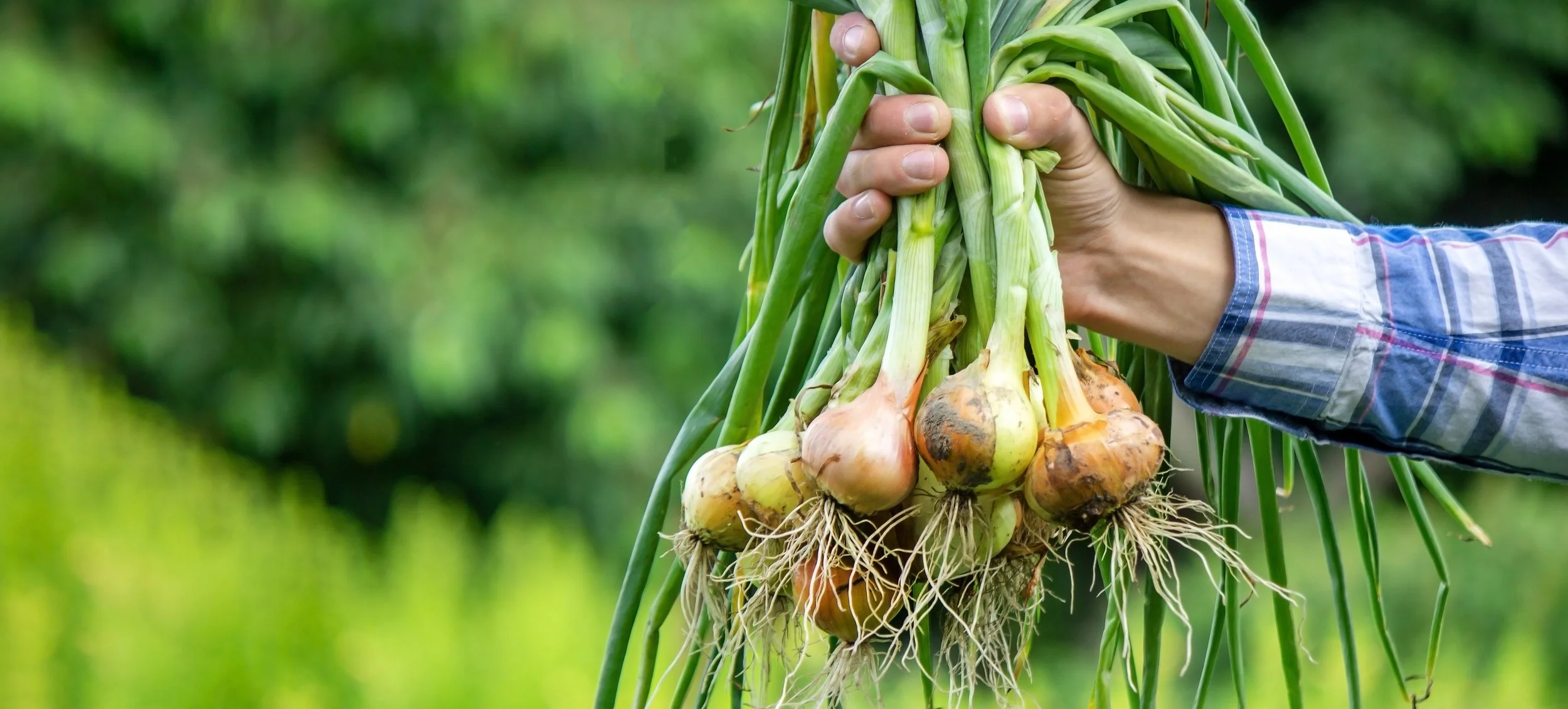
The Ancient Story of the Onion
Long before refrigeration, before global supply chains, before supermarkets and seed catalogs, there were onions.
The story of the onion stretches back thousands of years, deep into the soils of Central Asia, in the broad region that now includes parts of Iran, Pakistan, and surrounding territories. Wild alliums grew naturally in these climates, thriving in varied conditions and poor soils. Their hardiness made them attractive to early agricultural societies.
Unlike delicate fruits that bruised easily or leafy greens that wilted quickly, onions were durable. They could be pulled from the ground and stored and they traveled well. They could be eaten raw, cooked, dried, or preserved. In a world where food security was never guaranteed, these traits mattered deeply.
Ancient Egyptians not only cultivated onions, they revered them. The circular layers and spherical shape symbolized eternity. Onions appear in tomb paintings, and whole bulbs were discovered in burial chambers, including that of Tutankhamun. They were not simply food; they were sacred.
The Romans embraced onions wholeheartedly and carried them throughout Europe as their empire expanded. They became common fare among both soldiers and citizens.They became embedded in everyday cooking across the continent. By the Middle Ages, onions were one of the most widely grown vegetables in Europe, common in the kitchens of peasants and nobility alike.
When European settlers reached North America, they found that Indigenous peoples were already growing and using wild and cultivated onions. Over time, onion farming spread across the continent. Today, onions are grown on every inhabited continent in the world. From the cool fields of northern states to warm southern climates, from Europe to Asia to the Americas, onions have become universal.

Middle Kingdom tomb relief depicting a typical offering table of food for the afterlife: ox head, fish, bread, onion, and other food. From Brooklyn Museum.
Few foods are so globally integrated or so quietly essential.
The onion does not belong to one cuisine. It belongs to all of them.
What an Onion Really Is
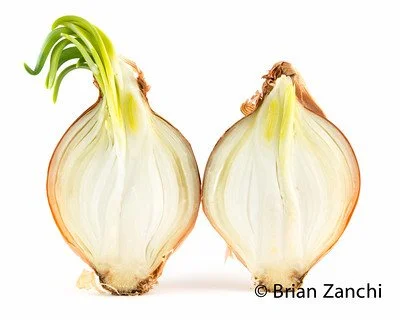
It is easy to assume that an onion is a root. After all, it grows underground. But botanically speaking, the common bulb onion, known scientifically as Allium cepa, is not a root at all. It is a bulb made up of tightly layered modified leaves. Each concentric ring you see when you slice through an onion is actually a fleshy leaf layer that once grew upward from the basal plate at the bottom of the bulb. Onions are biennial plants, completing their natural life cycle over two years, though they are typically harvested in their first year for culinary use. In its first year, it stores energy in the bulb beneath the soil and in its second year, if left unharvested, it sends up a tall flower stalk and produces seeds.
Onions belong to the allium family, alongside garlic, leeks, shallots, chives, and scallions. All share certain aromatic compounds that give them their characteristic scent and flavor.
Onions are also deeply sensitive to daylight. Their bulb formation is triggered by day length, which is why onion varieties are classified as long-day, short-day, or intermediate-day. Long-day onions require extended summer daylight hours and perform best in northern regions. Short-day onions are better suited to southern climates where daylight hours are shorter but more consistent. This botanical sensitivity explains why certain onions become famous in particular places.
The onion is not just a vegetable. It is a plant finely tuned to its environment.
Onion Varieties: Understanding the Differences
If you were to line up onions on a wooden table, their differences would be immediately visible. Papery skins range from golden amber to stark white to deep royal purple. Shapes vary from squat and round to elongated and tapered. But the differences go far beyond appearance.
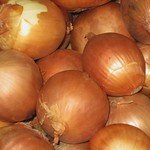
Yellow onions are the workhorse of the kitchen. Their papery skins range from golden tan to deep brown. Raw, they are assertive and sharp, releasing that unmistakable onion aroma the moment they are cut. But when cooked, especially when slowly sautéed or caramelized, yellow onions develop remarkable sweetness with notes that are savory and complex rather than sugary. They are ideal for soups, stews, braises, roasted dishes, and stocks. When a recipe calls simply for “an onion,” it almost always means a yellow onion.
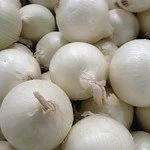
White onions are brighter in both appearance and flavor. Their skins are pale and thin, their flesh crisp and clean-tasting. They are especially common in Mexican cuisine, where finely diced white onions are scattered over tacos or folded into fresh salsas. Their sharpness holds up beautifully in raw applications, and when cooked quickly, they maintain a lively flavor profile.
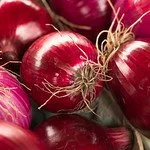
Red onions are as visually striking as they are versatile. Their deep purple skins and crimson-tinged interiors add vibrancy to salads and sandwiches. When thinly sliced and soaked briefly in cold water, their pungency softens, revealing a gentle sweetness beneath. Pickled red onions have become a modern kitchen staple, adding both acidity and color to grain bowls and roasted vegetables. Often used raw, they can certainly be cooked. Heat mutes their color somewhat, but their balanced flavor remains appealing.
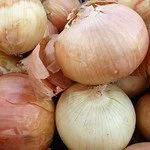
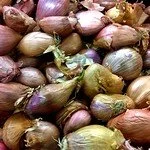
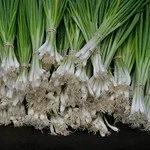
Sweet onions are grown in low-sulfur soils, which reduces their pungency and enhances their mildness. In the United States, onions from the Vidalia area in southern Georgia are among the most well-known sweet varieties. Walla Walla onions (from the Walla Walla valley region in southeastern Washington and northeastern Oregon) and Maui onions (grown in volcanic soil on the slopes of Mount Haleakala in Maui, Hawaii) have similarly earned devoted followings. Sweet onions are juicy and mild enough to slice thickly and eat raw without overwhelming your palate. They grill beautifully and roast into tender sweetness. Because of their higher water content, however, they are more perishable and do not store as long as yellow onions.
Shallots, smaller and elongated with coppery skins, offer a refined sweetness prized in French cooking. They dissolve gracefully into vinaigrettes and pan sauces, lending depth without overpowering other ingredients.
Scallions, also known as green onions, are immature onions harvested before a full bulb forms. Their white bases and hollow green tops offer a fresh, grassy onion flavor that bridges the gap between vegetable and herb.
Each variety has its own personality and knowing which to use is part of the craft of cooking allowing you to choose intentionally rather than automatically.
Growing Onions at Home
For the home gardener, onions offer both satisfaction and practicality. Onions prefer full sun and well-drained soil enriched with organic matter. They can be grown from seeds, sets, or transplants. Sets are often the easiest starting point for beginners.
Because onions are sensitive to day length, choosing the correct variety for your region matters. In northern climates, long-day onions perform best, forming bulbs as summer daylight stretches long into the evening.
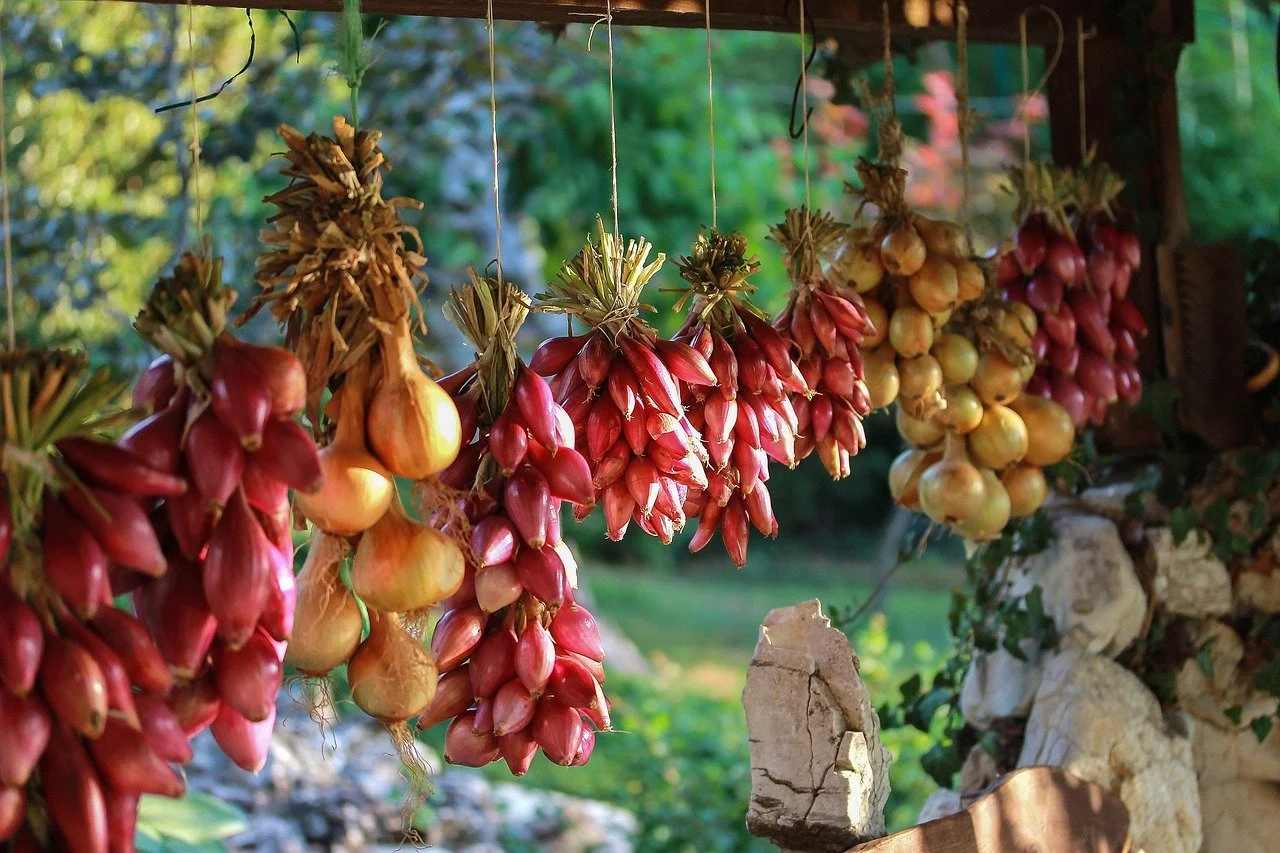
Curing onions.
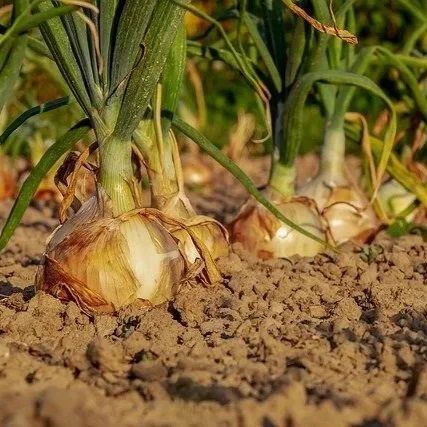
As onions mature, their green tops begin to yellow and fall over signaling that the bulbs are ready for harvest. But harvesting is only part of the process. Onions must cure. Spread out in a warm, dry, well-ventilated space for two to three weeks, their outer skins dry and toughen, preparing them for long term storage.
Properly cured onions can last for months when stored in a cool, dry, airy environment. Sweet onions, because of their higher moisture content, are more perishable and may benefit from refrigeration.
Growing onions teaches patience. From seed to harvest to curing, the process unfolds slowly.
Choosing and Storing Onions Properly
At the market, selecting onions well ensures better cooking later. A good onion feels firm and heavy for its size. The skin should be dry and papery, free from soft spots, moisture, or visible mold. Sprouting from the top suggests age.
Once home, onions need airflow. A cool pantry with good ventilation is ideal. Storing onions in sealed plastic traps moisture and shortens their shelf life so a mesh bag is preferred. They should not be stored near potatoes, which release moisture and gases that accelerate spoilage.
Once cut, onions should be wrapped tightly and refrigerated where they will keep for several days. Their aroma can be assertive, so sealing them well prevents their scent from permeating other foods.
Freezing chopped onions is an excellent way to wave time and reduce waste for up to 6-10 months. To avoid a frozen clump of onions, spread the chopped onions in a single layer on a baking sheet and freeze until solid. Transfer to heavy-duty freezer bags or airtight containers, squeezing out as much air as possible. They become soft when thawed, so they are best used in cooked dishes like soups, sautes, and sauces. They do not need to be thawed before cooking.
Simple attention to storage preserves their quality and flavor.
Why Onions Make You Cry
Anyone who has sliced an onion knows the sting.
When you cut into an onion, you rupture its cells. Inside those cells are enzymes and sulfur-containing compounds that are normally kept separate. When they mix, they create syn-propanethial-S-oxide, a volatile gas that rises into the air and irritates your eyes. Your tear glands respond by producing tears to flush it away.
A sharp knife minimizes cellular damage, reducing the amount of gas released. Chilling the onion slows the chemical reaction. Cutting near ventilation can help disperse the gas more quickly. But tears are part of the onion’s defensive design, a natural deterrent evolved over time.
Yet those same sulfur compounds that make you tear up are also responsible for much of the onion’s complexity. They are part of what makes onions indispensable in cooking because heat changes everything. As onions cook, the harsh edges soften. Moisture evaporates. Sugars concentrate. Browning reactions occur, creating complex flavor molecules that were not present before.
Few vegetables undergo such a dramatic metamorphosis from raw to cooked.
How to Cook Onions: From Sharp to Sweet
Raw onions are bold. Their flavor can be sharp, peppery, even biting. But heat transforms them in profound ways.
The simplest method is sweating. Onions are cooked gently in fat over low heat until they become translucent and soft without browning. This low, slow process draws out moisture and mellows sharpness creating a soft aromatic base that forms the base of countless dishes, from risottos to soups to sauces.
Increase the heat slightly and the onions begin to sauté. Edges take on light golden color and the aroma deepens as the browning reactions develop additional layers of flavor. But it is caramelization that truly showcases the onion’s potential.
Properly caramelized onions require patience. Sliced onions are cooked slowly over low heat, often for forty-five minutes or longer, with occasional stirring allowing the moisture to evaporate and the sugars to concentrate. First the onions turn golden, then amber, then deep brown. The result is silky, sweet, and intensely savory. Properly caramelized onions are not burnt; they are transformed.
Roasting onions at high heat produces a different effect. Halved or wedged onions tossed with olive oil develop crisp edges and tender interiors. Grilling thick slices creates smoky sweetness and visible char.
Pickling red onions in a simple mixture of vinegar, water, and salt preserves their crisp texture while adding acidity and brightness. Thinly fried onion rings deliver crunch and indulgence.
Across cuisines, onions serve as the aromatic backbone of beloved dishes. French onion soup from France depends entirely on deeply caramelized onions for its character. Onion bhajis from India transform sliced onions into crisp spiced fritters. In Mexico, raw onions brighten tacos and salsas. In Lebanon, slow-cooked onions crown mujaddara, lending sweetness to lentils and rice.
Learning how to cook onions well is not a small skill. It is foundational.
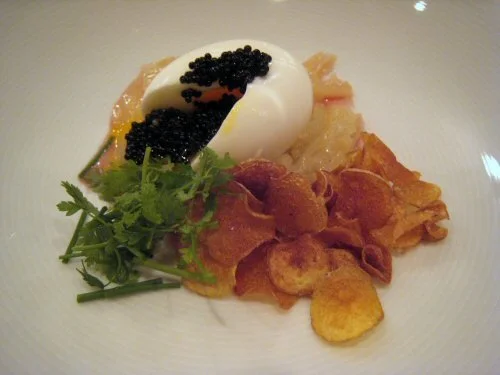
Momofuku Ko’s coddled egg with paddlefish caviar, onion soubise, potato chips, and chervil.
Interesting Facts About Onions: The Details Beneath the Layers
The longer you spend with onions, the more surprising they become. What feels like an ordinary pantry staple reveals an unexpectedly rich cultural and historical footprint.
For centuries, onions were valued not only as food but as currency. In parts of medieval Europe, onions were used to pay rent and were even offered as gifts. Their reliability and storability made them a practical form of exchange in agricultural communities where preservation mattered as much as harvest.

Onions have inspired festivals around the world. In Vidalia, the annual Vidalia Onion Festival celebrates the region’s famous sweet onions with parades, cooking contests, and community gatherings. This year’s event takes place April 23 - 26, 2026 and features Ashley McBryde in concert, the spectacular Blue Angels thrilling the skies in the airshow, cooking demonstrations, as well as the annual Vidalia Onion Run.
Similar celebrations take place in other onion-growing regions, honoring the harvest and the farmers who cultivate it.
The world’s largest onion, grown in the United Kingdom, weighed more than 18 pounds. Competitive vegetable growing has elevated onions from humble kitchen ingredient to record-breaking agricultural feat.
Even language reflects the onion’s layered structure. The phrase “peeling back the layers” is often used to describe uncovering complexity. It is no coincidence that we reach for the onion as metaphor. It is one of the most visually and structurally layered foods we know.
And perhaps most charmingly, onions were once carried by travelers as protection against illness and misfortune. Whether practical or symbolic, they were considered powerful provisions.
For an ingredient so often taken for granted, onions have left an outsized mark on agriculture, culture, language, and daily life. They may not command center stage, but they have quietly shaped the way the world cooks and eats.
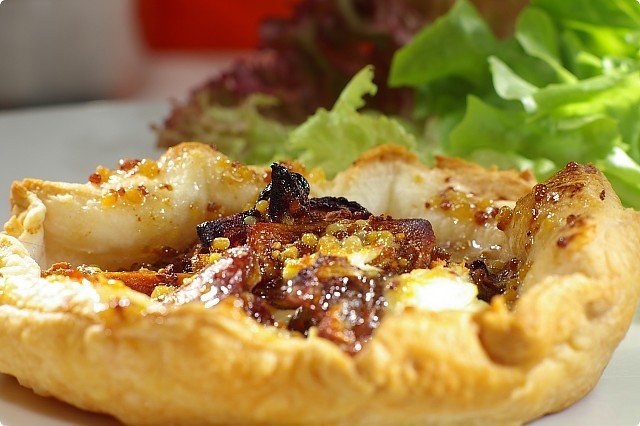
Sweet caramelized onion tart
The Nourishment Hidden in the Layers
Onions are more than a flavor boost; they’re everyday, food-level support for heart, metabolic, and immune health.
Their abundance of flavonoids, including quercetin, and various sulfur compounds help improve cholesterol patterns and blood pressure, calm inflammation in blood vessels, and lightly thin the blood, all of which support cardiovascular health over time. They also aid blood sugar control by improving insulin sensitivity and reducing low‑grade inflammation and oxidative stress, which is especially helpful in the context of metabolic syndrome or diabetes.
Onions have notable anti‑inflammatory and antioxidant effects, dialing down pro‑inflammatory signaling and supporting the body’s own antioxidant systems, creating a less disease‑promoting internal environment. Populations that eat more onions and related allium vegetables tend to have lower rates of certain digestive cancers, and lab work shows onion compounds can slow cancer cell growth and promote their death, suggesting a supportive role in an anticancer diet (though not a treatment).
Beyond that, onions may help protect bones by reducing inflammatory drivers of bone loss, support immune defenses with vitamin C and polyphenols, and offer mild antimicrobial and gut-supportive effects. The key is consistent, modest intake—roughly some onion most days—through raw or lightly cooked onions in salads, sautés, soups, and roasted dishes.
Onions in Dessert? The Sweet Side of a Savory Staple
It may sound improbable at first — onions in dessert — but once you understand how onions behave under heat, it becomes far less surprising.
When cooked slowly, onions release their natural sugars. The sharp sulfur notes soften and recede. What remains is sweetness layered with complexity, something deeper than simple sugar. Properly caramelized onions are not candy-sweet. They are rich, rounded, almost jam-like, with subtle savory undertones that make them intriguing rather than cloying.
Throughout history, there have been moments when onions crossed the boundary from savory to sweet.
In parts of Europe during times when sugar was scarce or expensive, onions were used to lend sweetness to baked goods. Medieval recipes sometimes included onions cooked down with honey or dried fruit. In England, variations of onion pie have existed for centuries, some incorporating raisins or currants to emphasize the sweet-salty contrast.
In modern kitchens, creative pastry chefs occasionally revisit this idea. Caramelized onion tarts might be finished with a drizzle of honey and a scattering of thyme, leaning gently toward the dessert spectrum. Onion jam layered into a galette with apples creates a sweet-savory interplay that feels sophisticated and unexpected.
There are even historical references to onion pudding — slow-cooked onions mixed with butter, bread, and a sweetening element, then baked until tender and cohesive. The result was less like a frosted cake and more like a custardy, rustic pudding, where sweetness and savoriness lived side by side.
The key to using onions in dessert lies in restraint and balance. Raw onion has no place in pastry. But caramelized onion, cooked until deeply golden and concentrated, can behave much like fruit compote. Its natural sugars have intensified. Its moisture has evaporated. Its flavor has mellowed.
Paired thoughtfully with apples, pears, figs, balsamic vinegar, brown butter, or dark chocolate, onions can create desserts that are subtle and intriguing rather than obvious. The goal is not to make the onion identifiable at first bite. It is to build complexity — that elusive “something” that makes a dessert feel layered and memorable.
This idea may challenge expectations, but it underscores a broader truth about onions. They are more adaptable than we give them credit for. We tend to confine ingredients to categories — savory or sweet, vegetable or fruit, base note or star. The onion resists easy categorization. Given time and heat, it transforms.
And transformation is what cooking is all about.
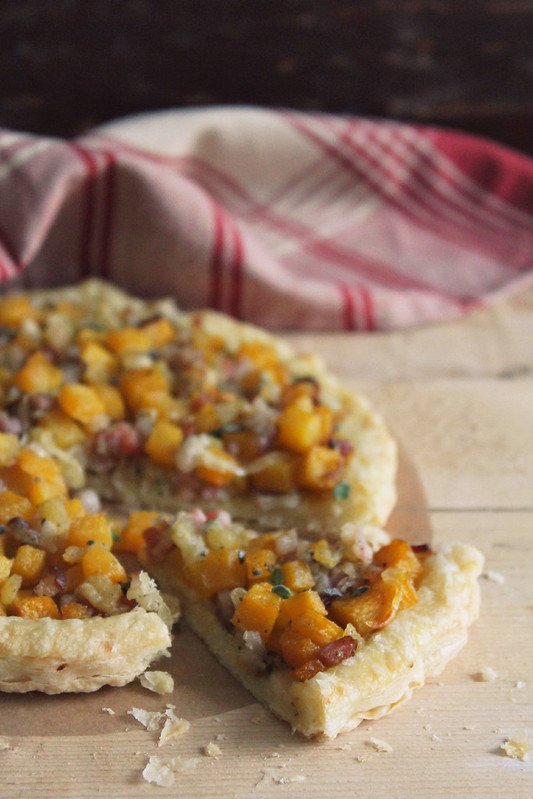
Apple & Pumpkin Pie with Caramelized Onion and Bacon
The Quiet Architecture of Flavor
Onions rarely receive applause making them easy to overlook. They are rarely plated whole and rarely earn headline status on a menu. They work behind the scenes, softening into sauces, disappearing into stews, forming the base of flavor structures we rely on without noticing.
But background does not mean unimportant.
In classical French cooking, the aromatic base known as mirepoix begins with onion. In Italian soffritto, Spanish sofrito, Cajun holy trinity, German suppengrün, and countless other culinary traditions, onion stands at the forefront of flavor development. Remove it, and the dish loses dimension.
The onion teaches a subtle lesson about cooking and perhaps about life. Not everything essential is visible. Not everything foundational demands attention.
When you slice into a dry, papery bulb and feel the resistance give way beneath your knife, when the familiar aroma rises and fills your kitchen, you are engaging in a ritual shared across centuries and continents. From ancient fields in Central Asia to modern home kitchens, onions have anchored meals and shaped cuisine.
Layer upon layer, they remind us that depth is built slowly and flavor is constructed patiently.
And foundation, though often unseen, is everything.
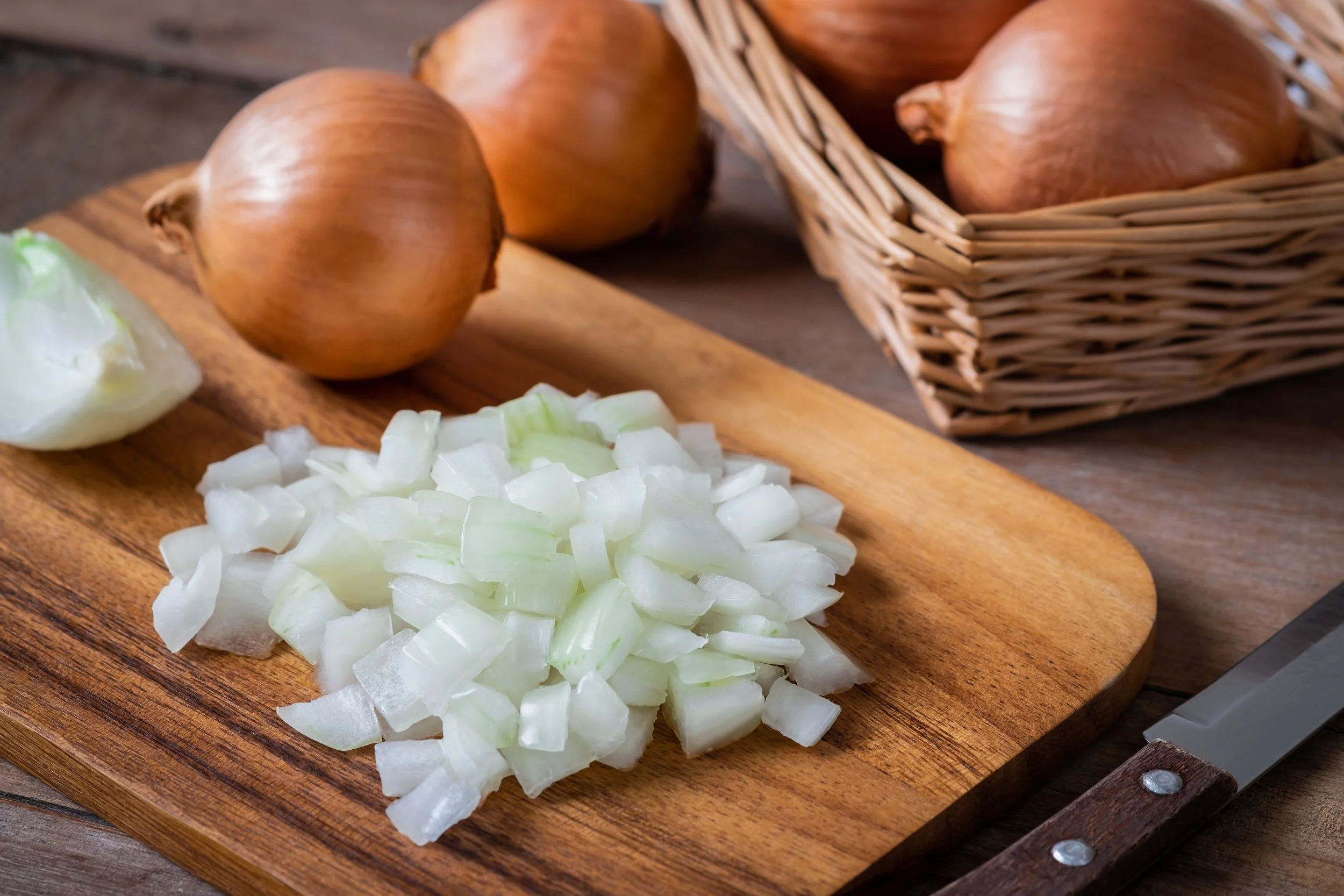
Let’s get cooking!
Onions are quietly transformative — sharp when raw, yet when tended with patience, they soften, deepen, and sweeten. They sizzle in the pan, release their aroma, and slowly build flavor that touches every dish. Onions remind us that even the most humble beginnings can create layers of richness and depth.
Caramelized Onion, Cabbage, & Ham Pasta
Caramelized Onion, Cabbage, & Ham Pasta is built on patience and layering. Thinly sliced onions are slowly cooked until golden and sweet, forming the aromatic base of the dish. Green cabbage joins the pan and softens into silky ribbons, absorbing the richness of the onions while adding gentle texture and body. Diced ham brings savory depth and a subtle smokiness that balances the natural sweetness of the vegetables.
A splash of chicken broth and reserved pasta cooking water create a light, glossy sauce that clings to every strand without feeling heavy. Fresh dill adds brightness and lift, while Parmesan melts into the pasta, rounding everything with quiet richness. Cracked black pepper ties it all together.
The result is comforting but not dense, deeply savory yet balanced — a simple, thoughtful pasta that feels both rustic and refined.
Caramelized Onion, Cabbage, & Ham Pasta
Ingredients
- 6 ounces whole grain pasta
- 1½ tbsp olive oil
- 1 large yellow onion (about 2–2½ cups thinly sliced)
- ¼ tsp sea salt (for onions)
- 3 cups thinly sliced green cabbage
- ¼ tsp sea salt (for cabbage)
- 4 ounces ham, diced
- 1–2 cloves garlic, minced
- pinch red pepper flakes (optional)
- ⅓ cup chicken broth
- ¾ - 1 cup reserved pasta cooking water
- ⅓ cup freshly grated Parmesan cheese, plus more for serving
- 2–3 tbsp chopped fresh dill
- Freshly cracked black pepper
- Salt to taste
- Optional: small squeeze of lemon juice
Instructions
- Heat olive oil in a large sauté pan over medium heat.
- Add onions and salt. Cook 5 minutes, stirring occasionally.
- Reduce heat to medium-low and continue cooking 25–30 minutes more until deeply golden and soft. If they begin sticking, add a tablespoon of water to deglaze and keep building flavor.
- While the onions are cooking bring a large pot of well-salted water to a boil. Cook pasta until just shy of al dente.
- Before draining, reserve at least 1 cup of pasta cooking water.
- Drain and set aside.
- Add sliced cabbage and salt to the cooked onions and cook 8–10 minutes until it softens and begins to caramelize at the edges. The cabbage should be tender and slightly silky, not crisp.
- Stir in diced ham, garlic, and optional red pepper flakes. Cook 2–3 minutes until fragrant and lightly heated through.
- Pour in the chicken broth and let it simmer 2–3 minutes, scraping up any flavorful bits from the bottom of the pan.
- Add drained pasta to the pan.
- Begin adding reserved pasta water, ¼ cup at a time, tossing continuously. The starch in the water will combine with the broth and cheese to create a light, glossy sauce.
- Add Parmesan and toss until melted and silky. If needed, add a bit more pasta water until the sauce lightly coats the pasta without pooling.
- Turn off heat. Stir in fresh dill and generous cracked black pepper.
- Taste and adjust salt.
- If desired, add a small squeeze of lemon juice to brighten everything.
- Serve with extra Parmesan on top.
Notes
Optional Variations
- Add a spoonful of crème fraîche for richness
- Stir in a handful of peas for spring brightness
- Use whole wheat pasta for a heartier feel
Savory Red Lentil & Scallion Crêpes
Savory Red Lentil & Scallion Crêpes are a study in simplicity and transformation. Soaked red lentils are blended into a smooth, pourable batter that cooks into thin, flexible crêpes — tender yet sturdy enough to wrap or fold. There’s no flour, no eggs, no fillers — just whole ingredients handled with intention.
Scallions are folded into the batter, bringing a subtle sharpness that softens as the crêpes cook. Their gentle onion flavor adds brightness without overpowering, creating depth in what might otherwise be a neutral base. The result is light but satisfying, with a delicate nuttiness from the lentils and a savory aroma as they cook in the pan. They can be filled with roasted vegetables, herbed cheeses, sautéed greens, or eggs, making them endlessly adaptable across meals.
Simple ingredients, thoughtfully prepared, creating something far greater than the sum of their parts.
Savory Red Lentil & Scallion Crêpes
Ingredients
- 1 cup dry red lentils (split)
- 1½ cups fresh water (plus more if needed)
- 3 scallions, thinly sliced
- 1–1½ tsp za’atar (depending on strength)
- ¼ tsp sea salt (reduce or omit if za’atar contains salt)
- Avocado oil or ghee for cooking
Instructions
- Rinse the red lentils thoroughly under cool running water until it runs mostly clear.
- Place in a bowl and cover generously with water. Soak for at least 3–4 hours, or overnight for the smoothest texture.
- Drain completely before blending.
- Add the drained lentils and 1½ cups fresh water to a high-speed blender.
- Blend until completely smooth and creamy, about 45–60 seconds. The texture should resemble heavy cream — pourable but not thin like water. If needed, add water 1 tablespoon at a time to adjust.
- Pour the batter into a bowl and stir in the sliced scallions, za’atar, and salt (if using).
- Let the batter rest for 15–30 minutes. This allows the lentils to fully hydrate and improves the final texture.
- Heat a well-seasoned cast iron or quality nonstick skillet over medium heat. Lightly brush with oil or ghee.
- Stir the batter before each crêpe, as the herbs and sesame seeds from the za’atar may settle.
- Pour about ¼ cup batter into the center of the pan and immediately tilt and swirl to spread thinly, just like a traditional crêpe. Aim for thin but not fragile.
- Cook for 1–2 minutes, until the surface looks set and the edges begin to lift naturally.
- Flip carefully and cook another 30–60 seconds on the second side.
- Transfer to a plate and repeat with remaining batter, lightly oiling the pan as needed.
- Stack the finished crêpes with parchment between them if making ahead.
Notes
- Refrigerate stacked crêpes in an airtight container for up to 4 days.
- Freeze flat between parchment for up to 2 months.
- Reheat gently in a skillet to restore texture.
There you have it!
Here’s to the humble onion — may it sizzle, soften, and sweeten your meals, and remind you that flavor often begins with the simplest of beginnings.