
Supporting Your Spine Every Day
If you’ve ever stood up after a long stretch of sitting and felt your back protest, you’re not alone. That stiff, slightly creaky feeling in the spine is something many people begin noticing in midlife. Sometimes it’s the neck that feels tight after looking down at a phone. Other times it’s the lower back after gardening, driving, or simply getting up from a comfortable chair.
For many people, these small signals from the body become a quiet reminder that the spine needs more attention than it once did.
But here’s the encouraging part: the spine is remarkably responsive. With a little awareness and a few supportive habits, it can regain flexibility, strength, and ease of movement.
What often works best is a combination of simple things: gentle daily movement, thoughtful posture, nourishing foods, and learning how the spine actually works.
When those pieces come together, the body often begins to feel lighter, more balanced, and more capable.

A Quick Tour of Your Spine
Many people experience back tension without really knowing much about the structure they’re feeling. You don’t need a medical degree to understand the basics of your spine, just a clear picture of what it does for you every single day.
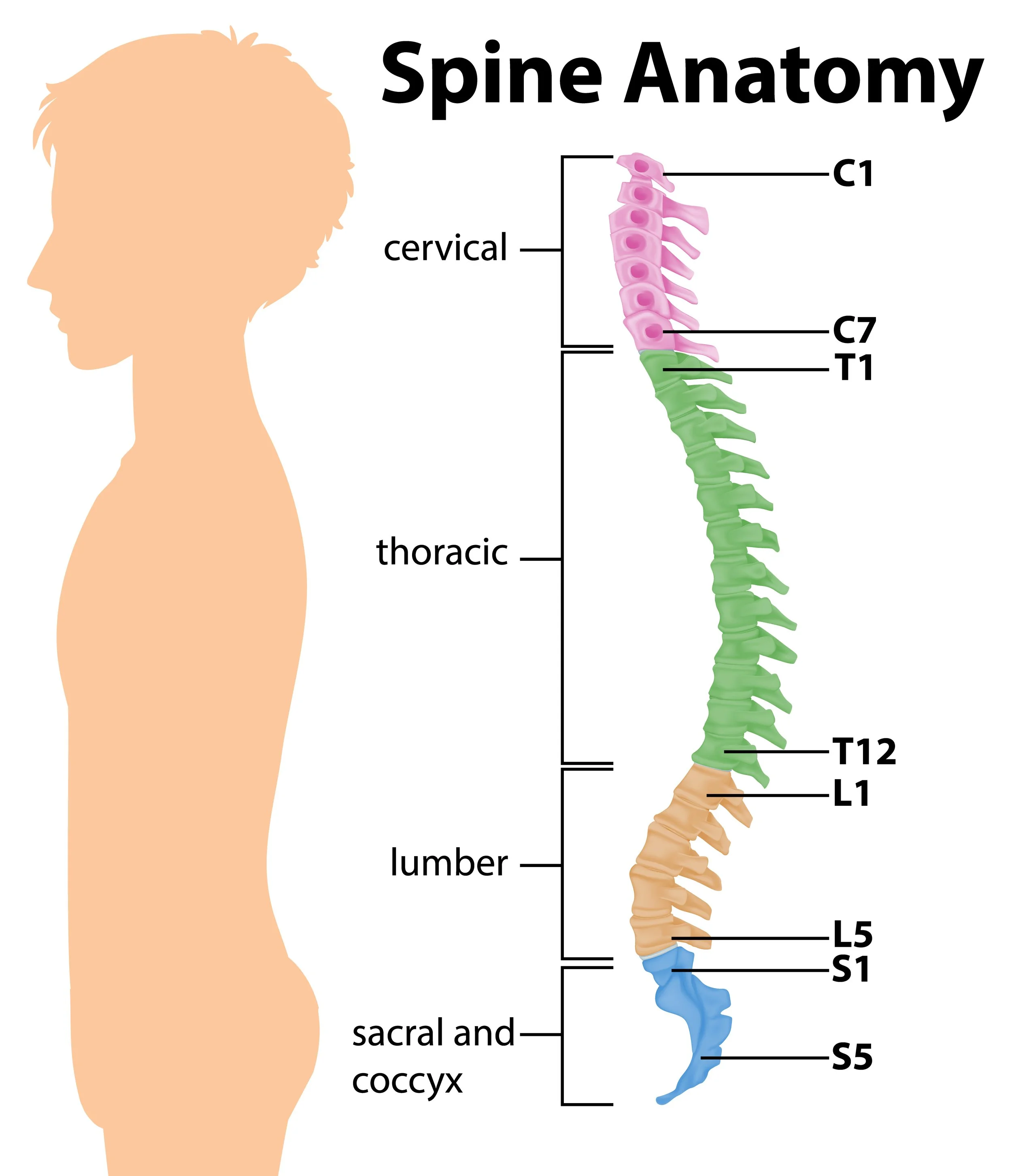
The spine is an elegant piece of engineering. It’s made up of 33 small bones called vertebrae, stacked like building blocks one on top of another from your neck to your pelvis, that creates a flexible column that supports the entire body.
These vertebrae are organized into regions:
The cervical spine, in the neck, contains seven vertebrae and supports the weight of the head. The head weighs about ten to twelve pounds, so these small bones and surrounding muscles work hard throughout the day.
Below that is the thoracic spine, the middle portion of the back where twelve vertebrae attach to the ribs. This region is designed for stability and protection of the lungs and heart.
Then comes the lumbar spine, the lower back, which includes five larger vertebrae built to bear much of the body’s weight.
At the base are the sacrum and coccyx, which connect the spine to the pelvis and form the foundation of the spinal column.
Between most of these bones are soft, gel-like cushions called discs. These discs act like shock absorbers, allowing the spine to bend, twist, and move while protecting the bones from grinding against each other.
Running through the center of the spine is the spinal cord, a delicate bundle of nerves that carries messages between the brain and the rest of the body.
When everything is working smoothly, the spine is both strong and surprisingly flexible, able to support us through walking, bending, lifting, and turning. A healthy spine lets you roll out of bed, lift groceries, play with grandkids, garden, and walk with ease. When the spine is stiff, weak, or overloaded, everyday activities can start to feel like a chore instead of a joy.
Why Posture Matters More in Midlife
When we’re younger, posture often takes care of itself. Muscles are strong, tissues are flexible, and the body naturally holds itself with ease.
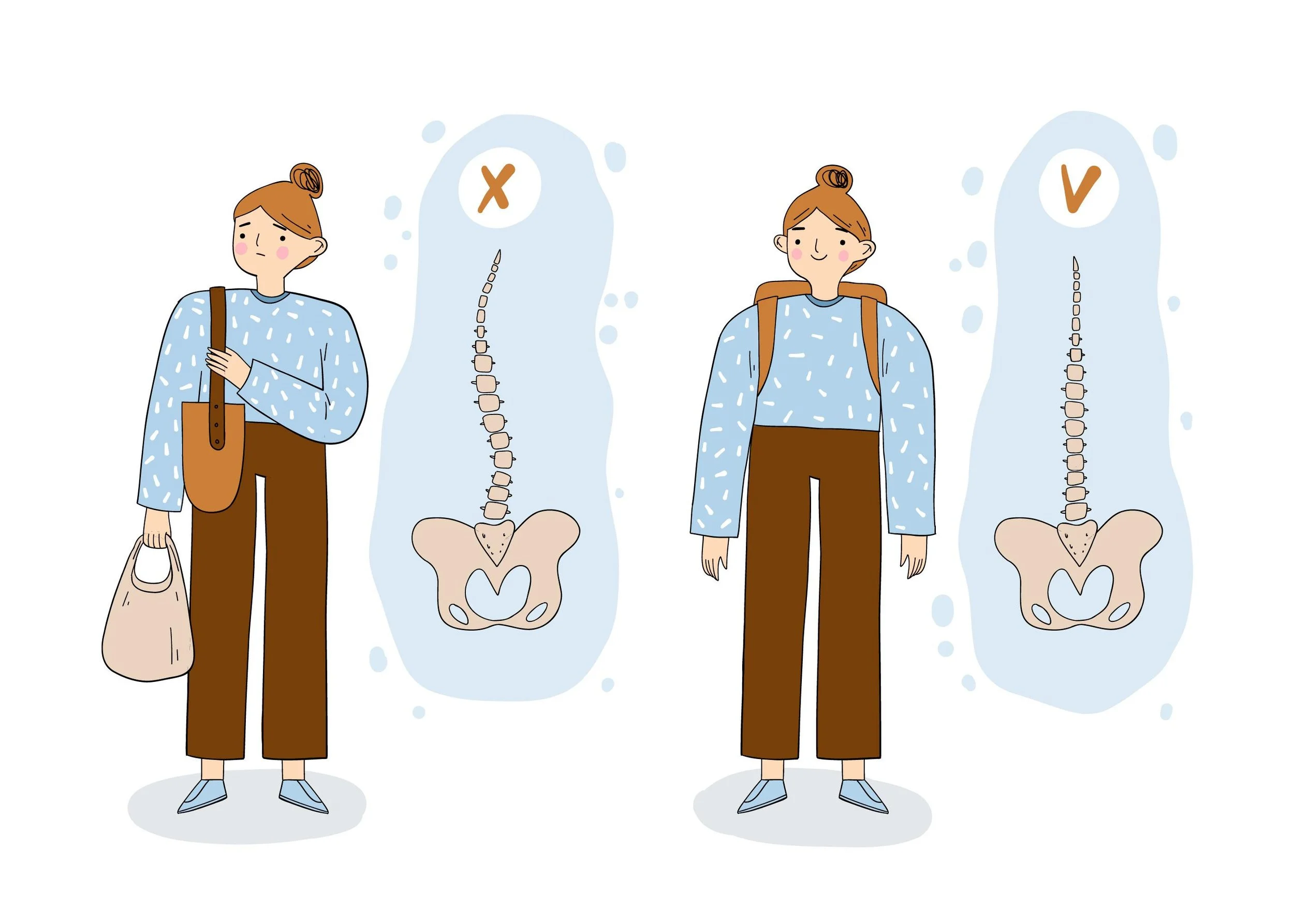
Over time, however, daily habits begin to shape how we carry ourselves. Hours spent sitting—at a desk, in the car, or looking at screens—can gradually pull the body forward. The shoulders round, the head shifts ahead of the body, the chest narrows, and the spine begins to lose its natural alignment. Even small habits like carrying a heavy bag on one shoulder or sleeping on an unsupportive pillow can slowly shift the body’s alignment.
These changes may feel subtle at first, but over the years they can lead to neck tension, back stiffness, and fatigue as muscles work harder than they should.
Posture Affects More Than Just How We Look.
It influences how the body functions throughout the day. When the spine is aligned well, the body has space to work as it was designed. Breathing becomes easier because the rib cage can expand fully and the diaphragm can move freely. When posture collapses, breathing often becomes shallow and restricted.
Digestion is also affected. Slouching compresses the abdominal area, which can slow the natural movement of food. A more upright position allows the organs to sit comfortably and function more efficiently.
Circulation depends on movement and space as well. When the body is held in tight or collapsed positions, blood and lymph flow may be less efficient. Upright posture, combined with regular movement, supports better circulation and overall energy.
Balance is closely tied to posture. When the head and upper body drift forward, the body’s center of gravity shifts, requiring the muscles of the neck, back, and hips to work harder to keep us upright. Over time, this can lead to fatigue and reduced stability. When the body is more aligned—head over shoulders, shoulders over hips—balance becomes easier and more natural.
In many ways, good posture is about efficiency. When the body is aligned well, the muscles don’t have to work as hard. The spine feels lighter, movement becomes easier, and everyday activities feel more fluid and comfortable.
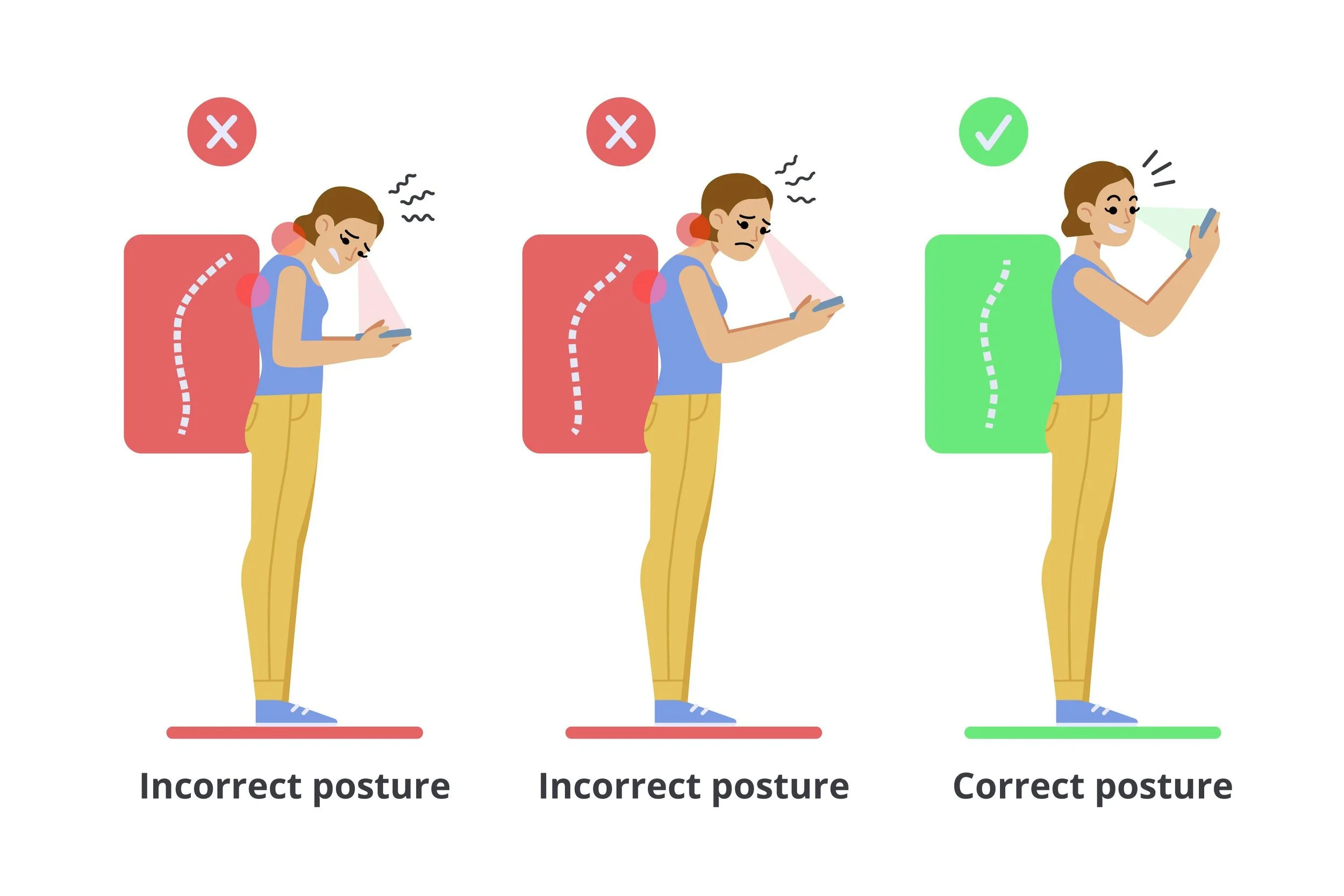
A Quick Posture Self-Check
Take a moment and notice how you’re sitting or standing right now.
Is your head slightly forward of your shoulders?
Are your shoulders rounding toward the front of your body?
Is your lower back collapsed into the chair?
Many people discover that while reading on a phone or computer, the body gradually drifts into a slouched position without us even realizing it.
A simple way to reset is to gently lengthen the spine as if a string were lifting the crown of your head toward the ceiling. Let the shoulders soften down and back, and allow the chest to open slightly. Take one slow, full breath.
You may notice that this small adjustment immediately creates a bit more space in the body. The breath feels easier, the neck relaxes, and the spine feels more supported.
These small moments of awareness throughout the day can quietly retrain the body toward better alignment.
Primal Posture: Simple Ways to Sit, Stand, and Lie
One of my favorite posture educators, Esther Gokhale, teaches what she calls “primal posture”—the way people in traditional cultures sit, stand, and rest with long, decompressed spines and very little back pain. Her approach is gentle, practical, and easy to weave into daily life.
1. Stretchsitting (how you sit)
In stretchsitting, you use the back of the chair to lightly traction your spine instead of slumping or rigidly “sitting up straight.” You sit with your hips back, gently anchor your mid‑back to the chair, and let your spine lengthen upward so the back muscles can relax while you sit. The video will show you how to set this up in your everyday chairs.
2. Tallstanding (how you stand)
Tallstanding teaches you to feel both grounded and elongated: feet steady under you, pelvis slightly behind (not tucked), chest open, and the crown of your head reaching gently upward. The aim is a long, J‑shaped spine—tall without tension or stiffness. The video will guide you through finding this easy, upright alignment.
3. Stretchlying (how you lie down and sleep)
Stretchlying turns resting time into quiet decompression for the spine. Whether on your back or side, you learn to position your body so the vertebrae gently lengthen away from each other and your neck and low back are supported, not compressed. The video will walk you through simple adjustments to your pillow, hips, and spine so your back can “reset” while you sleep.
These simple tweaks mean that every time you sit, stand, or lie down, you’re not just “holding good posture”—you’re subtly lengthening and decompressing your spine. Over time, that can translate into less tension, freer breathing, and a back that feels more supported doing the things you love.
The Hidden Role of Fascia
Another piece of the puzzle is a connective tissue called fascia. It’s a thin, strong, continuous web throughout the body that wraps around muscles, bones, nerves, and organs - including everything around your spine. It helps hold everything together while allowing tissues to glide smoothly during movement. When it’s healthy (hydrated, elastic, and free‑gliding), your vertebrae can move smoothly, loads are shared efficiently, and it takes less muscular effort to sit and stand tall.
Around the spine, fascial layers—especially the thoracolumbar fascia in the lower back—act like a built‑in tension system, helping transmit force between your trunk, hips, and legs. If this tissue becomes stiff, “sticky,” or irritated (from chronic poor posture, immobility, overuse, or injury), it can limit movement and become a direct source of back pain, even when discs look fine.

Fascia is also rich in nerve endings, so it plays a big role in your body’s sense of alignment and in how you feel pain. That’s why practices like varied daily movement, gentle stretching, posture work, walking, and myofascial therapies (massage, foam rolling, hands‑on fascial work) can be so helpful for spine health: they don’t just strengthen muscles, they also keep this fascial web around your spine supple, well‑hydrated, and better able to support a long, comfortable back.
Why Spine Health Matters for Whole‑Body Wellness
Spine health isn’t just about “having a good back.” It has ripple effects across your entire life:
Chronic back or neck pain can limit your mobility, reduce your activity levels, and sap your energy and mood.
When pain leads to less movement, muscles weaken, joints stiffen, and the cycle of discomfort can get worse over time.
Poor sleep, reduced social connection, and loss of independence are all common downstream effects when we ignore back and neck issues.
The upside: taking spine health seriously—especially starting in midlife—is one of the most powerful ways to preserve mobility, confidence, and independence as you age.
Move for Your Spine: Strength, Stretch, and Everyday Habits
You don’t need advanced yoga poses or heavy weights to support your spine. You need consistent, gentle movement that strengthens key muscles, maintains flexibility, and respects your body’s limits.
1. Strengthen Your Core and Hips Think of your core and hips as the “support team” for your spine. When these muscles are strong, they share the workload so your back doesn’t take every hit. You might include simple, accessible exercises like:
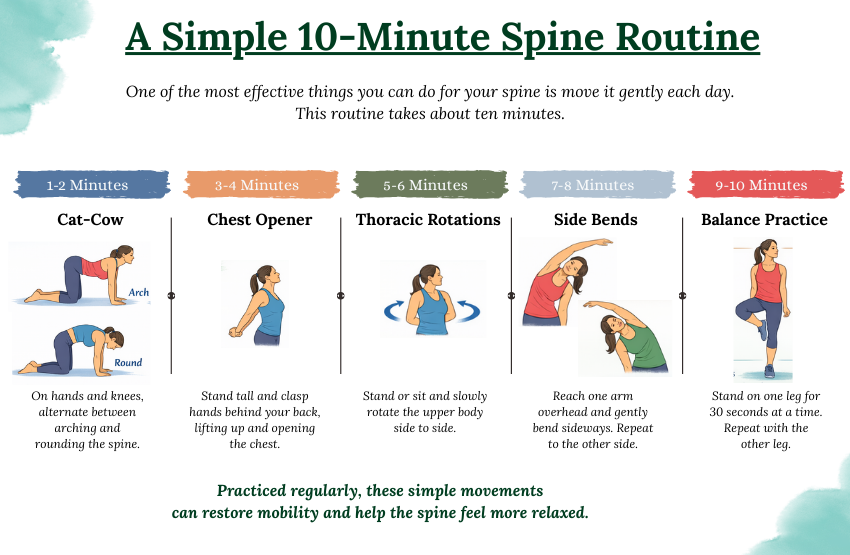
Pelvic tilts: Lying on your back with knees bent, gently rock your pelvis to flatten your low back into the floor, then release.
Bird dog: On hands and knees, extend one arm and the opposite leg, keeping your torso stable, then switch sides.
Glute bridges: Lying on your back, press through your heels to lift your hips, squeezing your glutes, then lower with control.
Supported wall sits: Slide your back down a wall until your knees are slightly bent, hold briefly, then return to standing.
Tips:
Move slowly and with control, never forcing through sharp pain.
Start with 1 set of 6–8 repetitions and build up gradually as tolerated.
If you have existing back issues, get clearance from a clinician or physical therapist before starting new exercises.
2. Gently Improve Flexibility and Mobility Stiff muscles around the hips, hamstrings, chest, and upper back can pull your spine out of its happy, neutral alignment. Consider a daily 5–10 minute “mobility snack” with:
Hamstring stretch: Gentle stretch at the back of the thigh.
Hip flexor stretch: A lunge‑style position, with support as needed, to open the front of the hip.
Chest opener: Hands behind your back (or on a doorway), gently opening the chest to counter rounded shoulders.
Thoracic rotation: Sitting or standing, gently rotate your upper body side to side within a comfortable range.
You can frame it as: “Move your spine in all directions every day—forward, backward, side‑to‑side, and gentle twists.”
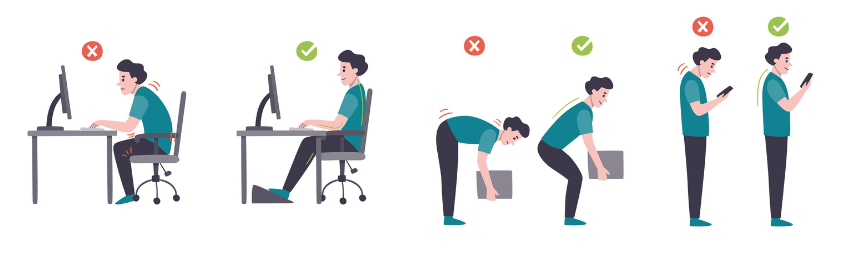
3. Posture and Ergonomics You Can Actually Maintain Perfect posture is not a rigid military position; it’s a dynamic, comfortable alignment you can sustain.
For sitting:
Feet flat on the floor, or supported on a small stool.
Hips slightly higher than knees to reduce strain on the low back.
Ears roughly over shoulders, shoulders relaxed, screen at eye level.
Stand up or change position every 30–60 minutes, even if just for a short stretch.
For standing:
Distribute weight evenly between both feet.
Avoid locking your knees or leaning into one hip for long periods.
Imagine a gentle string lengthening you up through the crown of your head.
For lifting:
Get close to the object instead of reaching and twisting.
Hinge from your hips, bend your knees, and keep your spine as neutral as possible.
Exhale as you lift and avoid sudden jerky movements.
Yoga for Spine Health: Dr. Loren Fishman’s Targeted Approach
Loren Fishman, MD, a physiatrist and yoga researcher, uses precise yoga poses to address back pain, scoliosis, and osteoporosis—especially in the spine—backed by his own clinical studies.
His method matches specific poses to conditions: for osteoporosis, a 12-pose daily sequence (tree, triangle, locust, bridge, etc.) held ~30 seconds each loads bone safely, with research showing improved spinal density in practitioners over time—no fractures reported across thousands of hours.
For back pain, he diagnoses causes like disc issues or stenosis, then prescribes asanas to decompress vertebrae, balance hips/core, and restore alignment (e.g., gentle backbends, side bends, hip openers).
In scoliosis, side plank on the concave side stands out: regular practice has curved spines noticeably in case studies.
Fishman’s yoga emphasizes safety—slow progression, alignment cues, medical clearance first—making it ideal for midlife+ adults building resilient spines through better posture, balance, and bone support. Start with his free online videos if cleared by your doctor.
Nourishing the Spine: Food, Inflammation, and Hydration
When we think about posture and the spine, we often focus on movement—stretching, strengthening, and alignment. But what we eat and drink quietly shapes how our body feels day to day, including how the spine is supported from the inside.

An Anti-Inflammatory Way of Eating
One of the most supportive approaches for the body—especially as we move through midlife and beyond—is to focus on anti-inflammatory nutrition.
Inflammation isn’t always a bad thing; it’s part of how the body heals. But when it becomes chronic, it can contribute to joint discomfort, muscle stiffness, and slower recovery. Over time, this can influence how easily we move and how comfortable the body feels in everyday positions.
A simple way to support the body is to build meals around whole, minimally processed foods.
This includes:
Colorful vegetables and fruits—think leafy greens, berries, carrots, peppers
Healthy fats like olive oil, nuts, and seeds
Omega-3 rich foods such as fatty fish, flaxseeds, and walnuts
Herbs and spices like turmeric and ginger, which add both flavor and gentle support
Rather than focusing on restriction, this way of eating is about adding in nourishment—foods that help the body feel more balanced and supported.
Over time, these choices can help support:
joint comfort
muscle recovery after activity
overall ease of movement
It’s not about a perfect diet, but about consistent, simple choices that add up.
Hydration and the Spine
Hydration is another often-overlooked piece of the puzzle.
Between each vertebra in the spine are discs that act as cushions. These discs are made up largely of water. When the body is well hydrated, they stay more supple and better able to absorb movement and pressure.
When hydration is low, those same discs can become a bit less resilient, which may contribute to feelings of stiffness or discomfort, especially after long periods of sitting or upon waking.
Hydration doesn’t have to mean constantly drinking large amounts all at once. In fact, the body tends to do better with steady intake throughout the day.
Some simple ways to support hydration:
Keep a glass or water bottle nearby and sip regularly
Start the day with a glass of water before coffee or tea
Include herbal teas as a gentle, warming option
Add broths or light soups, especially in cooler months
Eat water-rich foods like fruits and vegetables
These small habits can make a noticeable difference in how the body feels—less stiff, more fluid, and better supported.
Just like posture and movement, nutrition and hydration are not about perfection. They’re about daily patterns.
When the body is nourished with whole foods, supported with anti-inflammatory ingredients, and hydrated consistently, it creates a foundation that allows the spine—and the rest of the body—to move with greater ease.
When Self‑Care Isn’t Enough: Red Flags and Professional Help
Self‑care and lifestyle changes are powerful, but some situations need prompt professional attention. Encourage your readers to seek medical care promptly if they notice:
New or worsening weakness, numbness, or tingling in the legs or feet.
Loss of bladder or bowel control.
Severe back pain after a fall or accident.
Back pain accompanied by fever, chills, or unexplained weight loss.
Pain that is intense, constant, and not improving with rest or gentle measures.
Also, if a new exercise routine makes pain significantly worse instead of gradually better, it’s a sign to pause and consult a qualified clinician or physical therapist.
A gentle reminder: this article is for education, not diagnosis or treatment. It’s always okay—even wise—to bring questions from this post to a trusted healthcare professional.

The Takeaway
The spine supports you every day—through walking, bending, cooking, gardening, and all the movements that make up a full life.
Supporting it in return doesn’t require complicated routines.
It begins with small habits:
moving the spine regularly
strengthening supportive muscles
stretching tight areas
maintaining balance
and choosing nourishing foods
Over time, these simple practices can help the body feel more aligned, stable, and comfortable.
Sometimes the path to feeling better begins with something very simple:
standing a little taller, moving a little more, and giving the spine the care it quietly deserves.

Let’s get cooking!
Supporting the spine isn’t only about how we move—it’s also about how we nourish the body. The recipes that follow are simple, whole-food ideas designed to bring in ingredients that support muscle function, joint comfort, and overall ease in the body.
Think colorful, satisfying, and easy to incorporate into everyday life—small choices in the kitchen that complement the work you’re doing through movement and posture.
Creamy Honey Almond Fruit Dip
Creamy Honey Almond Fruit Dip comes together with a simple blend of Greek yogurt, white beans, and almond butter for a smooth, satisfying base. The beans add body and fiber, the yogurt brings a light tang and a burst of probiotics, and the almond butter adds a subtle richness and depth.
Honey and cinnamon provide just enough sweetness and warmth, while a hint of chipotle adds a quiet depth that keeps the flavor interesting without being spicy.
It pairs beautifully with fresh fruit like apples, pears, or berries, and also works well as a spread or part of a simple snack plate.
Creamy Honey Almond Fruit Dip
This creamy fruit dip has a gentle sweetness with warm cinnamon and a subtle hint of smoky chipotle. A blend of Greek yogurt and white beans creates a smooth, protein-rich base while almond butter adds richness and depth. It’s delicious with crisp apples, pears, strawberries, or bananas.
Ingredients
- ½ cup plain Greek yogurt
- ½ cup cooked white beans (cannellini or great northern), rinsed and drained
- 1/3 cup almond butter
- 1-2 tbsp honey (to taste)
- ¼ teaspoon ground cinnamon
- Very small pinch chipotle powder
- ½ teaspoon vanilla extract
- 1 tsp orange zest
- Pinch sea salt
Instructions
- Add the Greek yogurt and white beans to a food processor. Blend until completely smooth and creamy, about 45–60 seconds.
- Add almond butter, honey, cinnamon, chipotle powder, vanilla, orange zest, and salt and process until blended.
- Taste and adjust sweetness or spice if needed. If you'd like a slightly brighter flavor, blend in a teaspoon or two of lemon or orange juice.
- Chill for about 20–30 minutes before serving so the flavors come together.
- Serve with fresh fruit, celery sticks, and pretzels.
Notes
- Chef’s Tip: Use a very light touch with the chipotle—just enough to add a subtle warmth in the background. The goal is a whisper of smokiness, not heat.
- This dip pairs well with crisp apples, pears, and bananas.
Pistachio Pumpkin Cake
This Pistachio Pumpkin Cake offers a different take on a familiar ingredient. Instead of leaning into the deeper, spiced flavors often associated with pumpkin, this version feels lighter and more balanced, with a subtle sweetness and a gentle nuttiness throughout.
Pumpkin brings moisture and a tender texture, creating a soft crumb that holds together beautifully without feeling dense. Finely ground pistachios add a delicate richness and a slightly earthy note that pairs naturally with the pumpkin, giving the cake a more nuanced flavor.
The sweetness is mild and clean, allowing the ingredients to come through rather than compete. A touch of vanilla rounds things out, while the pistachios add just enough texture to keep each bite interesting.
This cake works well as a simple everyday bake—something to enjoy with coffee or tea, or as a lightly sweet snack. It can be served as is, or dressed up with a spoonful of yogurt or a light drizzle of honey for a little extra finish.
Pistachio Pumpkin Cake
Ingredients
- dry ingredients
- 1 cup almond flour
- ½ cup ground pistachios
- 2 tbsp arrowroot or tapioca starch
- ½ teaspoon baking soda
- ¼ teaspoon salt
- ¼ teaspoon cardamom
- wet ingredients
- 1 cup pumpkin purée
- 3 eggs
- ½ cup honey
- 2 tbsp avocado oil or melted butter
- 1 tsp vanilla
- 1 tbsp lemon zest
- 1 tbsp orange zest
- 1 tbsp lemon juice
- 1 tbsp orange juice
- lemon yogurt topping
- ½ cup Greek yogurt
- 1 tbsp honey
- 1 tsp lemon juice
Instructions
- Preheat the oven to 325°F. Line a 9 x 5 inch loaf pan with parchment paper.
- In medium bowl combine the almond flour, ground pistachios, arrowroot/tapioca starch, baking soda, salt, and cardamom.
- In a large bowl, whisk together the pumpkin purée, eggs, honey, avocado oil, vanilla, lemon and orange zests, and lemon and orange juices until smooth.
- Fold the dry ingredients gently into the pumpkin mixture until fully combined.
- Pour the batter into the prepared pan and smooth the top.
- Bake for 45-55 minutes, or until the center is set and a toothpick inserted in the middle comes out clean.
- Allow the cake to cool in the pan for about 15 minutes, then remove and let cool completely on a rack.
- Make the lemon yogurt topping in a small bowl by stirring together the Greek yogurt, honey, and lemon juice until smooth.
- Serve slices of the cake with a spoonful of the yogurt topping and a sprinkle of chopped pistachios. Add fresh berries if you like.
Notes
- If the top begins browning too quickly, loosely tent with foil for the final 10–15 minutes.
- Let the cake cool in the pan for 15–20 minutes before removing. Flourless cakes slice best once completely cooled.
There you have it!
Sometimes the most meaningful changes come from simply paying attention. The body is always adapting to what we ask of it and with a little intention, we can begin to guide it back toward balance and ease.