
Body Literacy: Reconnecting With Your Body's Natural Wisdom
Have you ever noticed how much attention you give to everyone else during the course of a day? You remember appointments, answer texts, solve problems, make decisions, prepare meals, meet deadlines, and somehow keep track of a hundred little details that help life run smoothly. Many of us have become experts at reading the people around us, noticing when a friend seems troubled, when a spouse is stressed, or when a family member needs support.
But when was the last time you stopped and really listened to what your own body was trying to tell you? For many women, that's not a question we ask ourselves very often.
We're so busy responding to the demands of daily life that we can easily lose touch with the messages our bodies send us throughout the day. We tell ourselves we'll slow down later, rest later, pay attention later and before long, we become surprisingly disconnected from the one companion that's been with us through every moment of our lives.
The interesting thing is that our bodies are always communicating with us - the messages are there. The challenge is that many of us were never taught how to recognize them, let alone interpret them.
That's what body literacy is all about - recognizing, understanding, and responding to the signals your body sends every day. The more fluent you become in the language of your own body, the better equipped you are to make choices that support your health, energy, and overall well-being.
And like learning any language, it starts with listening.
A Quick Note Before We Continue
Before we go any further, I think it's important to pause for a moment and talk about what body literacy isn't. Because if you've spent any time in the health and wellness world, there's a good chance you've encountered messages that encourage you to constantly monitor yourself, optimize every aspect of your health, track every symptom, or search for the perfect solution to every discomfort. It's easy to see why the idea of paying closer attention to your body might sound like one more thing to manage.
That's not what we're talking about here.
Body literacy isn't about scrutinizing yourself or becoming preoccupied with every sensation you experience. It isn't about trying to achieve perfect health, eliminate every ache and pain, or become the world's leading expert on your own physiology. Nor does it require special equipment, detailed tracking, or hours spent analyzing your habits and behaviors. It's actually much simpler than that.
Body literacy is about developing a more intuitive relationship with yourself by recognizing that your body is continually providing feedback and allowing yourself to notice it with curiosity rather than judgment. It’s a distinction that matters because curiosity feels very different from criticism.
When we're critical, we're often looking for problems. We're searching for what's wrong, what needs fixing, or where we've somehow fallen short. Curiosity approaches the same experience from an entirely different place. It simply asks, "That's interesting. I wonder what's going on there?" That shift alone can change the way we relate to ourselves.
The goal isn't to become more controlling over how you live your life, or creating another wellness project or adding another responsibility to your day. If anything, it's about slowing down just enough to reconnect with something that has always been there.
What Is Body Literacy?
Learning to Recognize the Clues
If body literacy could be summed up in a single sentence, it might be this:
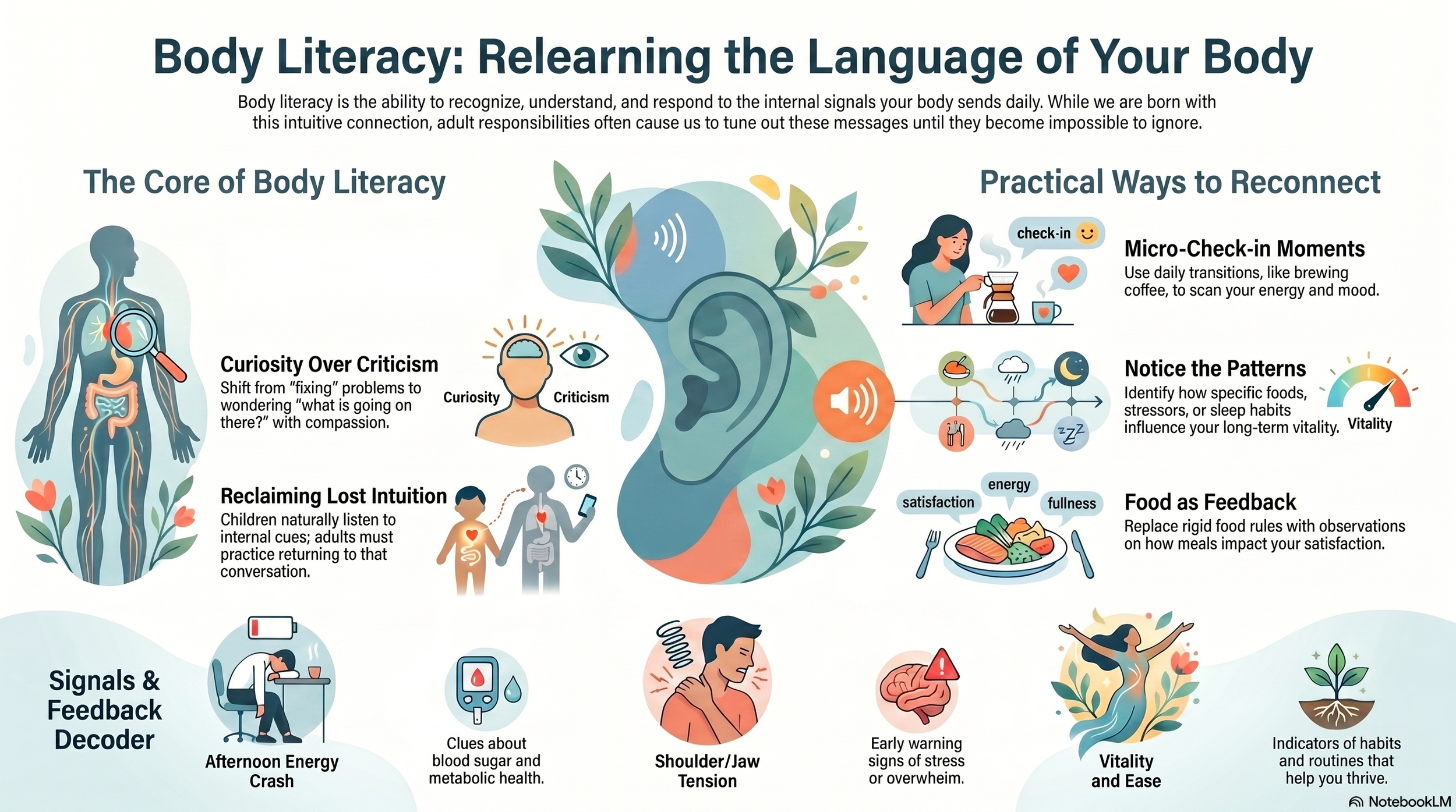
Body literacy is the ability to recognize, understand, and respond to the signals your body sends every day.
That sounds simple enough, but most of us have never been taught how to do it.
We're taught how to read a clock, follow a schedule, meet expectations, and care for the people around us. We learn how to navigate school, work, relationships, and responsibilities. Yet very few of us are taught how to pay attention to our own internal experiences.
As a result, many of us move through life responding to our bodies only when they become impossible to ignore - noticing hunger when we're starving, fatigue when we're exhausted, or stress when we're overwhelmed. We notice discomfort only when it becomes loud enough to interrupt our plans.
But our bodies are communicating long before they reach that point.
Most of us recognize the obvious messages of hunger, sleepiness, and stress. But the body communicates in many other ways as well and the truth is that many of us gradually adapt to feeling less than our best. What once caught our attention slowly becomes normal. We stop questioning the afternoon energy crash, the bloating after meals, the restless sleep, or the nagging stiffness because they're familiar. They become part of the background noise of everyday life.
Sometimes these experiences are exactly what we think they are—a consequence of a busy week, a stressful season, or simply getting older. But sometimes they're clues. Small pieces of feedback that offer insight into how well our bodies are functioning and what they may need from us.
This is where body literacy comes in.
You Know More Than You Think
Body literacy is the practice of noticing those signals, becoming curious about them, and considering what they might be telling you. Not with fear or judgment, and not with the expectation that every sensation requires an explanation, but with compassionate awareness.
It's about learning what is normal for you - recognizing your body's unique patterns, understanding what helps you feel energized and well, and becoming aware when something feels different or out of balance. When this happens, health professionals, books, and research all have important roles to play in getting you back into balance, but there is one thing they can never know as intimately as you do: your day-to-day experience of living in your own body. You know when your energy is different, your digestion feels off, or when something simply doesn't feel quite right, even if you can't yet explain why.
Body literacy begins by valuing that knowledge.
It's recognizing that your body has been providing feedback your entire life and that those signals are worth noticing. The more familiar you become with your own patterns, the more insight you gain into what supports your health, energy, and overall well-being.
In many ways, body literacy is less about learning something new and more about rediscovering a conversation that has been happening all along.

Why We Lose Touch With These Signals
The interesting thing about body literacy is that it's not something we completely lack. In many ways, it's something we once intuitively knew.
What Children Know Naturally
Watch a young child and you'll often see body literacy in action. They eat when they're hungry and stop when they're full. They move when they have energy and rest when they're tired. If they're exhausted, they may fall asleep in the car, on the couch, or in the middle of an afternoon without giving it much thought.
Children are naturally connected to their internal signals because they haven't yet learned to tune them out.
The Shift From Inward to Outward
As we grow older, however, our attention gradually shifts outward. We learn to follow schedules, meet expectations, care for others, and manage responsibilities. We eat because it's lunchtime, not necessarily because we're hungry. We stay awake because there is work to finish, even when we're tired. We push through discomfort because there are things that need to get done.
These aren't bad lessons. Many of them help us function in the world and care for the people we love. But they can come with an unintended consequence: we become so focused on what's happening around us that we stop noticing what's happening within us.
Over time, hunger, fatigue, stress, tension, and even feelings of well-being fade into the background as our attention is pulled toward the next task, the next obligation, or the next thing demanding our time.
Reconnecting With Something That Was Never Lost
If this sounds familiar, there’s no reason for self-criticism because you’ve failed to listen to your body. You've simply spent years developing skills that helped you navigate life in a busy world.
The encouraging news is that the connection isn't gone because those signals are still there. Body literacy is simply the practice of bringing your awareness back to a conversation that has been ongoing all along.

The Signals Your Body Sends Every Day
So what does this conversation with your body actually sound like?
Everyday Signals We Often Overlook
The answer is different for each of us, which is one of the reasons body literacy is such a personal practice. While there are common signals that most people experience, the way your body communicates may not be exactly the same as the way it communicates with someone else. The important thing is not memorizing a list of symptoms but learning to recognize the patterns that show up in your own life.
Some messages are relatively easy to recognize. Hunger reminds us that we need nourishment, fatigue encourages us to rest, and stress often announces itself through physical sensations such as tension in the shoulders, a clenched jaw, shallow breathing, or a knot in the stomach. Most of us have experienced these signals often enough that we know what they feel like, even if we don't always respond to them.
Other messages can be more subtle, particularly when they've been present for so long that we've come to accept them as normal. Perhaps your energy fades significantly in the afternoon and you automatically reach for another cup of coffee without giving it much thought. Maybe you wake up feeling stiff most mornings and assume it's simply part of getting older. Digestive discomfort, restless sleep, frequent headaches, food cravings, or feeling mentally foggy may have become such familiar companions that they've blended into the background of daily life.
This is where body literacy becomes valuable. Instead of immediately dismissing these experiences or accepting them as inevitable, we become curious about them. We begin asking gentle questions. Is this how I usually feel? Has something changed? Is there a pattern here? Are there certain habits, foods, situations, or seasons of life that seem to influence what I'm experiencing?
Midlife Changes and Hormonal Shifts
For women, these questions often become particularly important during midlife. Hormonal shifts associated with perimenopause and menopause can bring changes that seem to arrive without warning. Sleep may become less predictable, energy levels may fluctuate, recovery after exercise may take longer, and experiences such as brain fog, hot flashes, mood changes, or weight redistribution may leave women feeling as though they no longer recognize their own bodies.
While these changes can certainly be frustrating, they are also part of an ongoing process of adaptation. The body is adjusting to a new stage of life and providing valuable feedback along the way. The more aware we become of those changes, the better equipped we are to respond with patience, understanding, and appropriate support.
Blood Sugar, Energy, and Metabolic Health
The same can be said for blood sugar and metabolic health, which affect far more people than many realize.
A tendency toward afternoon fatigue, intense cravings for sweets, feeling irritable when meals are delayed, difficulty concentrating, or riding a cycle of energy highs and lows throughout the day may all provide clues about how efficiently the body is managing and using energy.
None of these experiences automatically point to a specific problem, but they are worth noticing because they may reveal patterns that help guide healthier choices.
Sexual Health Is Part of the Conversation Too
Even aspects of health that we don't always discuss openly can be part of this conversation.
Changes in sexual desire, intimacy, comfort, or arousal are often connected to factors such as stress, fatigue, relationship dynamics, hormone fluctuations, sleep quality, and overall health. Rather than viewing these changes as something to ignore or feel embarrassed about, body literacy encourages us to recognize them as another form of feedback and approach them with curiosity rather than judgment.
When Your Body Is Thriving
What I find most interesting about body literacy, however, is that it isn't only about recognizing discomfort. Some of the most valuable insights come from paying attention to the times when we feel genuinely well.
Think about a period in your life when your body felt balanced and supported. You likely weren't thinking about your digestion because it was working smoothly. You weren't constantly focused on your energy because it was steady and reliable. You moved comfortably, slept reasonably well, recovered from stress without too much difficulty, and generally felt capable of meeting the demands of your day.
Life still had challenges, of course, but your body wasn't demanding constant attention.
Those experiences offer valuable clues as well. They help us identify the habits, routines, foods, relationships, and forms of self-care that support our well-being. Just as discomfort can point us toward areas that may need attention, a sense of vitality, ease, and resilience can teach us a great deal about what helps us thrive.
Among all the ways the body communicates, there is one area that deserves special attention because it touches nearly every aspect of our health and daily lives: our relationship with food.

A Special Note About Food
Before we continue, I'd like to pause for a moment and talk about food. It’s one of the most common ways we interact with our bodies, yet for many people it has also become one of the most complicated.
Moving Beyond Food Rules
Spend a few minutes on social media and you'll find no shortage of opinions about what you should eat, when you should eat, how much you should eat, what foods to avoid, and what foods are supposedly the key to better health. It's easy to come away feeling as though every bite needs to be analyzed, optimized, or justified. In the middle of all that noise, it's easy to lose sight of something important: food is not a test you either pass or fail.
Body literacy invites us to approach food from a different perspective.
Replacing Judgment With Curiosity
Rather than asking whether a meal was "good" or "bad," we can become curious about how it affected us.
How did we feel afterward? Were we satisfied? Did we have steady energy, or did we find ourselves searching for a snack an hour later? Did the meal leave us feeling nourished and comfortable, or sluggish and uncomfortable?
These questions aren't meant to create another layer of self-monitoring. They are simply opportunities to learn from our experience.
For many of us, years of dieting, food rules, and conflicting nutrition advice have taught us to look outside ourselves for answers. We become focused on following the plan, counting the points, avoiding the ingredient, or eating according to someone else's rules. In the process, we may stop paying attention to our own experience.
Food as Nourishment, Pleasure, and Connection
Body literacy gently brings our attention back to our experiences. It reminds us that food is more than a collection of nutrients - it’s nourishment, pleasure, tradition, culture, celebration, comfort, and connection. A healthy relationship with food makes room for all of those things.
This doesn't mean nutrition doesn't matter. It does. But body literacy encourages us to become partners with our bodies rather than adversaries so that instead of judging ourselves for what we eat, we can become curious about what our bodies are telling us.
Learning From Your Experience
Perhaps a protein-rich breakfast helps you feel energized throughout the morning. Maybe certain meals leave you feeling satisfied for hours while others don't. Perhaps eating slowly helps you recognize fullness more easily, or maybe you notice that stress has a greater influence on your food choices than hunger does. None of these observations are reasons for criticism, they’re simply insights into how your body is responding to your food choices.
The goal is not to eat perfectly, it's to understand yourself a little better. When we replace judgment with curiosity, food becomes less about following rules and more about learning. And that learning can become one of the most valuable conversations we have with our bodies.
If body literacy begins with awareness, the next question becomes how we create more of those moments in everyday life.
Practical Ways to Build Body Literacy
It’s good to know that building body literacy doesn't require a major life overhaul. You don't need a new planner, a health tracker, or a detailed system for monitoring every aspect of your day. More often than not, body literacy develops through small moments of awareness woven into everyday life.

Create Small Moments of Awareness
The challenge isn't that our bodies aren't providing feedback but that many of us move through our days so quickly that we rarely pause long enough to notice it. So one of the simplest ways to begin is to create brief check-in moments throughout the day. They don't need to be formal or time-consuming. In fact, some of the most meaningful observations happen in just a few seconds.
For example, while waiting for your morning coffee or tea to brew, you might ask yourself how you're feeling as you start the day. Are you rested? Tired? Energized? Rushing? Then, when you sit down for lunch, you might notice whether you're truly hungry or simply eating because the clock says it's time. Later on during an afternoon walk, you might check in with your energy level, your mood, or whether your body feels tense or relaxed.
You’re not trying to come up with answers or figure out what is going on during these check-in moments. The goal is simply to notice the dialog that is already there.
Notice the Patterns
As these moments of awareness become more familiar, you may find yourself recognizing patterns that previously went unnoticed. You may discover that certain foods leave you feeling energized while others leave you sluggish. You may notice that your shoulders tighten during stressful weeks or that poor sleep affects your mood more than you realized. You may begin to recognize the early signs of stress, fatigue, or overwhelm before they become impossible to ignore.
This is where body literacy becomes especially valuable. Taken on their own these individual experiences may seem random, but when you step back you’ll see patterns that often tell a much richer story. Over time, those patterns can help explain why you feel your best on some days and less like yourself on others.
Rather than judging those experiences as they happen, simply become curious about them. Curiosity creates space for learning whereas judgment often shuts it down.
The Value of Reflection and Journaling
You might find it helpful to write down some of your observations although this is definitely not required. It doesn't need to be an elaborate journal or daily record. Just a few simple notes at the end of the day can often reveal patterns that are difficult to see in the moment.
You might jot down a few thoughts about your energy, sleep, mood, digestion, stress level, or anything else that stood out during the day. Over time, these observations can paint a surprisingly clear picture of how your habits, routines, relationships, and environment influence your well-being.
Some people prefer a traditional journal while others keep a small notebook on the kitchen counter or make a few notes on their phone before bed. The method matters far less than the practice of reflection itself. Remember the goal here isn’t about collecting data. It’s to become more familiar with your own experiences.
Curiosity Over Criticism
Perhaps the most important thing to remember is that body literacy is built through curiosity, not criticism.
If you notice that you're tired every afternoon, don’t judge yourself for it. If stress is affecting your sleep, don’t blame yourself. If you realize that certain habits aren't serving you as well as they once did, there is no need for guilt or self-criticism because the goal is not perfection but understanding.
Every observation offers another piece of the puzzle and, over time, those small observations begin to add up. What once felt like random experiences start to reveal patterns, and those patterns can help guide choices that better support your health and quality of life.
Body literacy won’t happen all at once. It develops one moment of awareness at a time. And often, those seemingly small moments are enough to spark a much deeper understanding of yourself than you ever expected.
The Benefits of Becoming More Body Literate
One of the most interesting things about body literacy is that the benefits often extend far beyond the signals themselves.

Better Awareness, Better Decisions
At first, you may begin noticing practical things. You recognize when you're becoming stressed before it turns into overwhelm. You become more aware of what supports steady energy throughout the day. You notice patterns in your sleep, digestion, mood, or food choices that were previously easy to miss.
These insights can help you make more informed decisions about how you care for yourself. Over time, they may contribute to better sleep, more consistent energy, improved stress management, a healthier relationship with food, and a greater sense of overall well-being.
But perhaps the most meaningful benefit is something less tangible.
Building Trust in Yourself
The more you listen to your body, the more familiar it becomes. You begin to understand its rhythms, its preferences, and its unique ways of communicating and over time, this awareness often leads to a deeper sense of trust.
Rather than feeling frustrated by your body or disconnected from it, you begin to work with it. You become more confident in your ability to recognize what you need and respond appropriately. You learn when you need nourishment, movement, rest, connection, quiet, challenge, or support.
In many ways, body literacy is an ongoing process of getting to know yourself. And just like any meaningful relationship, it deepens and strengthens when we invest time and attention in it.
Why Caring for Yourself Matters
For many women, this can feel surprisingly unfamiliar. We spend years focusing on the needs of family, work, friends, and countless responsibilities that fill our days. We become skilled at caring for others, often without realizing how little attention we've given to our own needs along the way.
Body literacy doesn't ask us to stop caring for others. It doesn't require us to become self-centered or ignore our responsibilities. Rather, it reminds us that caring for ourselves is part of caring for others.
There's a reason flight attendants tell us to put on our own oxygen mask before assisting those around us. It's not because other people don't matter. It's because we're in a much better position to help when we've first taken care of ourselves. The same principle applies to the relationship we have with our own well-being.
When you understand your body's needs and respond to them with greater awareness, you often have more energy, patience, resilience, and capacity to give to the people and responsibilities that matter most. You're not choosing yourself instead of others. You're recognizing that your well-being affects every aspect of your life, including your ability to show up for the people you love.
A Relationship That Lasts a Lifetime
Ultimately, body literacy isn't about achieving perfect health or eliminating every discomfort. It's about developing a relationship with yourself that is built on awareness, understanding, and trust. And that's a relationship that will support you for the rest of your life.
Conclusion: Returning to the Conversation
Most of us spend our lives becoming fluent in the language of responsibility. Along the way, however, it's easy to lose touch with another language—one that has been with us since the very beginning - the language of our own bodies.
For much of our lives, we've been taught to pay attention to what others need from us. Body literacy reminds us that there is value in paying attention to what we need as well—not instead of caring for others, but so that we can continue showing up for them with greater energy, resilience, and well-being.
It’s not about achieving perfect health or becoming hyper-focused on every sensation. It's not another wellness project to add to an already busy life. If anything, it's an invitation to slow down just enough to notice what has been there all along. An invitation to become more curious, more aware, and more trusting of your own experience.
Over time, those small moments of awareness can grow into something much larger. They can help you better understand your needs, make more informed choices, and develop a deeper sense of connection with yourself. What begins as a simple observation—I'm tired today. I'm feeling stressed. That meal left me feeling energized.—can gradually become a source of wisdom and self-understanding.
And perhaps that's the real gift of body literacy. Not that it helps us fix ourselves, but that it helps us know ourselves.
So the next time your body sends a signal—whether it's hunger, fatigue, tension, calm, satisfaction, or joy—consider treating it as the beginning of a conversation rather than an interruption.
You may discover that your body has been offering guidance all along. The only thing it has been waiting for is your attention.
Let’s get cooking!

One of the simplest ways to begin reconnecting with your body is through the everyday act of preparing and enjoying a meal. Cooking for yourself is more than preparing food - it’s an opportunity to explore what supports your energy, satisfaction, and well-being, one meal at a time.
Turkish Lamb Moussaka
This healthy Turkish Lamb Moussaka takes inspiration from traditional Turkish moussaka, where eggplant and meat are cooked together rather than layered. Roasted eggplant adds depth and texture to a flavorful lamb and tomato mixture seasoned with coriander, paprika, oregano, and cinnamon.
Served over rice and topped with a refreshing dill-mint yogurt sauce, this satisfying meal is packed with Mediterranean flavor and made with everyday ingredients. It's a wonderful option for those seeking wholesome comfort food that doesn't feel heavy.
Perfect for meal prep or a cozy family dinner, it's a delicious way to bring the flavors of Turkey to your table.

Turkish Lamb Moussaka
Ingredients
- For the Moussaka
- 2 medium eggplants, cut into ¾-inch cubes (about 1 ¼ pounds)
- 1 tbsp olive oil, divided
- 1 pound lean ground lamb or beef
- 1 ½ cups diced onion
- 1 ½ cups diced green bell pepper
- 3 cloves garlic, minced
- 1 tsp paprika
- 1 tsp ground coriander
- ½ tsp dried oregano
- ¼ tsp cinnamon
- 1 tbsp tomato paste
- 1 can (14 ounces) diced tomatoes
- 2 cups low-sodium broth
- ¼ cup fresh parsley, chopped
- Salt and freshly ground black pepper, to taste
- 3 cups cooked rice
- For the Dill-Mint Yogurt Sauce
- ⅔ cup plain Greek yogurt
- 1 tbsp fresh dill, finely chopped
- 1 tbsp fresh mint, finely chopped
- 1 tbsp lemon juice
- salt and black pepper, to taste
Instructions
- Preheat the oven to 425°F (220°C).
- Spread the eggplant cubes on a large baking sheet and toss with a small amount of olive oil, salt, and pepper if desired.
- Roast for 25–30 minutes, stirring halfway through, until tender and lightly caramelized around the edges.
- Heat half of the olive oil in a large Dutch oven or deep skillet over medium heat.
- Add the lamb and cook until browned, breaking it into small pieces as it cooks.
- Remove from pan and pour off the extra fat.
- Add the remaining olive oil, onion and green pepper and sauté for 5–6 minutes until softened.
- Stir in the garlic, paprika, coriander, oregano, cinnamon, and tomato paste. Cook for 1 minute until fragrant.
- Return the cooked lamb to the pan, add the roasted eggplant, diced tomatoes and broth and bring to a gentle simmer.
- Cover and cook for 15–20 minutes, stirring occasionally, until the eggplant is tender and beginning to break down into the sauce.
- Stir in the fresh parsley and season with salt and pepper to taste.
- While the moussaka is cooking, make the Dill-Mint Yogurt Sauce. In a small bowl, combine the Greek yogurt, dill, mint, lemon juice, salt, and pepper.
- Stir until smooth.
- To serve, spoon the cooked rice into bowls or onto plates.
- Top with generous portions of the lamb and eggplant mixture.
- Add a dollop of dill-mint yogurt sauce.
- Garnish with additional dill, parsley, and a squeeze of lemon if desired.
Cherry Chocolate Pudding
Rich, creamy, and loaded with chocolate flavor, Cherry Chocolate Pudding proves that simple ingredients can create something truly special. Frozen cherries bring natural sweetness and a subtle tartness that balances the richness of cacao powder, while avocado and cottage cheese create an incredibly smooth, mousse-like texture.
What sets this pudding apart is its nutritional staying power. Cottage cheese provides high-quality protein, while avocado contributes heart-healthy fats that help make this dessert both satisfying and nourishing. Together, they transform a classic sweet treat into a snack or dessert that can help curb cravings and keep hunger at bay.
Perfect for meal prep, healthy snacking, or a simple dessert, this Cherry Chocolate Pudding comes together in minutes and tastes like a treat you'll want to make again and again.

Cherry Chocolate Pudding
Ingredients
- ½ cup frozen dark cherries
- 1 ripe avocado
- 1 cup cottage cheese
- 4 tbsp cacao powder
- 2–3 tbsp honey (adjust to taste)
- ¼ tsp almond extract
- Pinch of sea salt
- 2–4 tbsp milk of choice (if needed for blending)
- Optional Toppings
- Fresh cherries
- Chopped toasted almonds
- Cacao nibs
- Shaved dark chocolate
Instructions
- Add all ingredients to a blender or food processor.
- Blend until completely smooth and creamy, scraping down the sides as needed.
- Taste and adjust sweetness if desired.
- Chill for at least 30 minutes before serving for the best texture.
- Garnish as desired and serve.
Notes
Variations - for each one replace almond extract with 1 tsp vanilla
- Orange Chocolate: add 1 teaspoon orange zest, tiny pinch of cinnamon
- Mexican Chocolate: add ½ teaspoon cinnamon, pinch of cayenne pepper, pinch of espresso powder
- Mocha Chocolate: add: 1–2 teaspoons espresso powder, extra teaspoon of honey if needed
- Raspberry Chocolate: add ½ cup fresh or frozen raspberries
- Salted Caramel Chocolate: add 1 tablespoon date paste, flaky sea salt for topping
- Mint Chocolate: add ¼ teaspoon peppermint extract
- Chai Chocolate: add ½ teaspoon chai spice
There you have it!
Be gentle with yourself as you begin. Body literacy isn't about getting everything right; it's about building a deeper relationship with yourself, one small moment of awareness at a time. Your body has a story to tell, and it's never too late to start listening.