
Strong for Life: What Functional Fitness Really Means
There are a lot of things we do every day without thinking of them as fitness activities. We carry several bags of groceries from the car because we’d rather make one trip than two, haul a basket of laundry upstairs, reach into a high cupboard, spend an afternoon working in the garden, climb in and out of the car, or get down on the floor to play with a child and stand back up again after we’re done. When our bodies can handle those things fairly easily, we don’t give them much thought—they’re simply part of life.
Then one day you start noticing little changes. Maybe the bag of potting soil feels heavier than it used to, or you notice yourself using the arm of the chair to help you stand. Maybe you think twice before sitting on the floor because you’re already wondering how you’ll get back up, or a full day of walking while traveling leaves you much more tired than you expected. Those moments can be easy to brush off because bodies do change as we get older, and some change is inevitable. But they can also be useful reminders that fitness isn’t only about exercise. It’s about having enough strength, balance, mobility, and stamina to keep doing the things that make up your life.

That’s really what functional fitness is about. It isn’t training so you can become better at exercising. It’s training so your body can continue supporting the life you want to live.
What does functional fitness actually mean?
The term functional fitness sounds more complicated than it really is. You might equate it with a TV commercial showing someone swinging kettlebells, sweating on a stationary bike, or lifting a heavy barbell, but functional fitness shows up in something as ordinary as unloading the dishwasher. The basic idea behind functional fitness is developing the physical abilities we use in everyday life.
In reality, the terms we use in the gym are the same ones we use when talking about functional fitness: strength, balance, mobility, and endurance. We may talk about each of these separately, but everyday life rarely asks us to use just one ability at a time. Walking up the stairs takes leg strength, balance, coordination, and endurance. Getting up from the floor requires mobility as well as enough strength to lift your body. Walking across uneven ground asks your feet, ankles, legs, and nervous system to keep making tiny adjustments so you stay upright. And if you stumble, strength and balance matter, along with enough mobility to take that quick corrective step.

Looking at fitness this way changes the conversation so that instead of asking, How much exercise should I be doing? we can ask something much more personal: What does my life require my body to be able to do?
Strength is what lets you move through your life
It’s easy to picture a buff Arnold Schwarzenegger pumping iron when the topic of strength comes up. Realistically, though, most of the strength we use every day happens nowhere near a gym. Strength is what allows you to stand up from a chair, climb stairs, carry groceries, move a flowerpot, lift a suitcase into the car, pull open a heavy door, or pick something up from the floor. And it becomes increasingly important as we get older because muscle mass and strength tend to decline when they aren’t regularly challenged.
It’s well documented that resistance training can help slow muscle loss and improve strength well into later life. But six-pack abs and well-toned arms matter much less than your ability to manage everyday life with relative ease. Imagine two people carrying the same 15-pound bag of groceries. One carries it comfortably and could easily add another bag, while the other has already reached her limit. They’re doing exactly the same task, but the amount of effort it requires is very different. That extra reserve the first person has matters. The stronger you are, the less of your total capacity ordinary life requires, and that affects how easily you move through your entire day.

Strength gives you a little more room to work with. When your muscles can handle more than everyday life usually asks of them, the rest of your movement tends to feel easier too. You have more to draw on if you lose your balance, more control when you bend or reach, and more left in the tank at the end of a long day. Strength isn’t the only thing that matters, but it gives you a solid base for everything else your body needs to do.
Balance matters most when you’re not thinking about it
Balance is our ability to stay oriented and controlled as our position changes, and while your senses and nervous system play a big part in it, strength matters too. It’s one thing for your body to recognize that you’re losing your balance and it’s quite another to have enough strength and coordination to quickly step, shift your weight, or steady yourself.
Yoga instructors know that standing on one foot is a perfectly good way to practice balance, especially if you progress to doing it with your eyes closed when it’s safe to do so. But daily life rarely gives us the luxury of balancing while standing still on an even surface in a quiet room–real-life balance is way messier than that. You step from pavement onto grass, turn while carrying a laundry basket, walk across an uneven trail, step over a garden hose, reach sideways for something, or misjudge the edge of a curb.
These everyday situations are part of the reason balance becomes more important as we age. But it doesn’t have to become one more item to add to the to-do list, especially if you tuck a little balance practice into something you already do. You can practice your balance by making simple tweaks to the activities you already do every day like standing on one leg (with a counter nearby if needed) while waiting for the coffee to brew, brushing your teeth, or washing your hands, alternating legs halfway through. Other more deliberate activities like yoga, tai chi, walking on varied terrain, stepping in different directions, or simply practicing movements that require you to control your body in different positions can all challenge and improve your balance.

Often the most useful fitness activities give us several benefits all at once. Staying balanced, for example, isn’t just about holding yourself steady. You also need to be able to step far enough, turn when you need to, reach in different directions, and have enough freedom of movement to adjust to whatever is happening. That’s where mobility starts to matter.
Mobility keeps movement available
Mobility is one of those fitness words that gets used a lot, often as if it means the same thing as flexibility, but there’s an important difference. Flexibility is about how much range of motion is available in a muscle or joint while mobility is whether you can actually move through that range comfortably and with control. That difference shows up all through everyday life. You need enough movement through your shoulders to reach overhead to put the glasses into the cupboard, through your hips and ankles to squat down when you’ve dropped a spoon on the floor, and through your spine to turn and look behind you while maneuvering a shopping cart. Getting down onto the floor to play with the dog and then getting back up again asks even more of you because several joints have to move together while you stay in control of your body.
The goal here isn’t extreme flexibility, and most of us aren’t trying to become gymnasts. We just want enough comfortable movement available so the things we care about don’t gradually become harder simply because we stopped moving in those directions. If reaching, bending, squatting, or turning starts to feel awkward, it’s easy to do a little less of it, and over time that range of movement can shrink even more. It’s the classic example of move it or lose it.

This is another place where strength comes back into the picture. Having enough mobility to lower yourself toward the floor is useful, but you also need enough strength to control the movement and bring yourself back up. Mobility gives you the freedom to move; strength helps you stay in control through that movement. But being able to move well is only part of what everyday life asks of us. We also need enough energy and stamina to keep going once we get started, whether that means walking through an airport, working in the garden for the afternoon, or spending a day exploring somewhere new. That’s where endurance comes in.
Endurance gives you enough energy to enjoy what you can do
Having strong legs might help you climb a flight of stairs, but what helps you keep going after you reach the top is endurance. Being able to walk across a parking lot at the mall is one thing, but spending an entire afternoon walking around a museum or exploring a new city, hiking a new trail with friends, or rushing between concourses at an airport with luggage is another. If you don’t want to have to frequently stop to catch your breath, let your breathing settle, and give tired muscles a break, then you’ll need endurance.
Cardiovascular or aerobic endurance is what allows us to sustain activity over time. Walking, cycling, swimming, hiking, dancing, and other forms of continuous movement strengthen the heart and lungs and build the stamina we use in daily life. Your muscles need endurance too because the same muscles may have to keep working for a long time. Even standing for a long stretch asks the muscles that support your posture to keep doing their job.
Strength and endurance aren’t interchangeable, though, and everyday life gives us plenty of examples of that. You may be able to walk several miles without giving it much thought but struggle to lift your suitcase into the overhead bin. Someone else may have no trouble lifting the suitcase but find herself looking for a place to sit after walking through a large airport. Neither ability tells the whole story. The easier we want everyday life to feel, the more useful it is to have some reserve in both.

And this is where an important distinction starts to show up: being active throughout the day does a lot for our health, but if our days keep asking our bodies to do the same few things, some abilities may get plenty of practice while others gradually get left behind.
Your body does what you ask it to
One of the beautiful aspects of our bodies is that they adapt to what we regularly ask them to do. This is one of the principles that make functional fitness work. Your body becomes familiar with the tasks you do often, making those movements more likely to stay comfortable and available to you, while the ones you stop doing can gradually become less familiar and eventually harder. If you walk the dog twice a day, spend weekends kayaking, sweep the kitchen every night, or routinely haul laundry from one end of the house to the other, your body learns how to handle those movements with less effort. The flip side is that when certain movements gradually disappear from your life—like squatting down to look in the oven or standing on your toes to clean the back of the microwave—your body has less reason to stay good at them.
That change can happen so slowly that you barely notice it. Maybe you stop taking the shortcut across the uneven field because the sidewalk feels easier, or you find yourself choosing a seat that’s easier to get in and out of. Maybe you avoid reaching into the back of a deep cupboard, step around a puddle instead of over it, or ask someone else to move the awkward box because it feels like more trouble than it’s worth. None of those choices matter much on their own, but over time, as our routines become narrower, so can the range of movements our bodies are accustomed to making.
This is where staying active in a variety of ways really matters. It doesn’t mean turning every part of your day into exercise or constantly trying to make things harder. It simply means continuing to give your body different kinds of jobs to do and different ways to move so it doesn’t settle too comfortably into the same limited patterns. Walk on different surfaces. Take the longer route once in a while. Reach, bend, twist, step over, climb around, play with the dog, shovel a little snow, or try something you haven’t done in a while. Sometimes the challenge is physical, and sometimes it’s simply asking your body to move in a way it hasn’t had to lately.
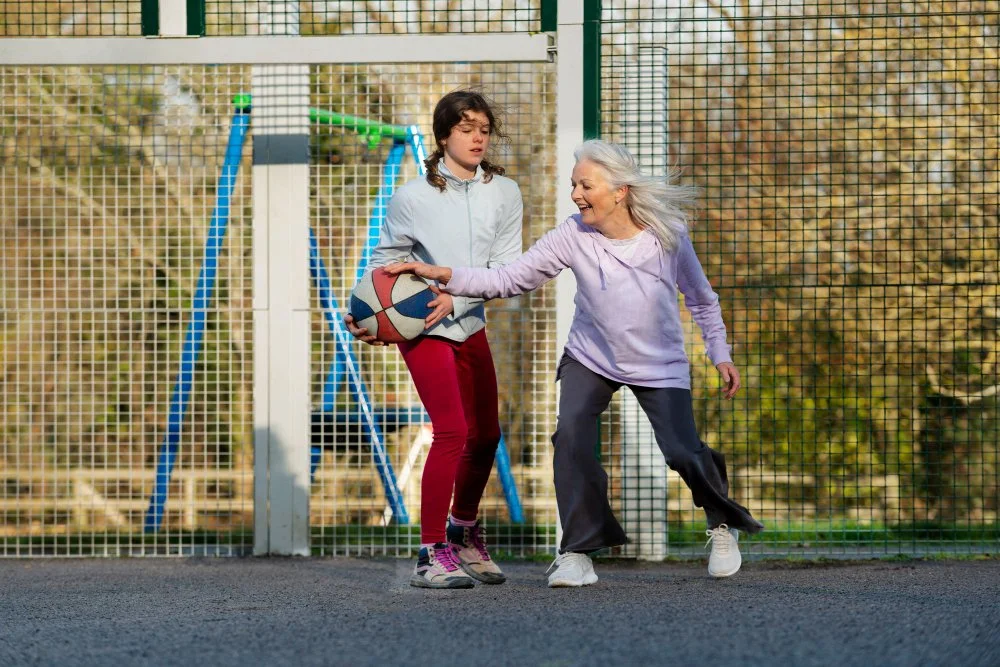
What feels challenging will be different for everyone, and that’s exactly the point. Functional fitness isn’t about checking off a list of exercises or proving that you can still do everything you did years ago. It’s about keeping enough variety and challenge in your movement that your world doesn’t slowly get smaller simply because your body has forgotten how to do some of the things you still want to do.
Make your movement fit your life
This is where functional fitness becomes very personal. There isn’t one right way to do it because there isn’t one life we’re all trying to prepare for. Someone who spends weekends camping is asking something very different of her body than someone who spends a day at a local festival, cooks a large family meal, keeps up with a favorite hobby, volunteers at the food bank, or spends much of the day sitting and wants enough energy left to enjoy the evening.
Think about your own ordinary week. What does your life ask your body to do over and over again? Maybe you’re on your feet a lot, climbing stairs, caring for animals, doing yard work, driving long distances, or moving between sitting and standing all day. Those routines tell you a lot about the strength, balance, mobility, and endurance you already use. They may also show you where things have gotten a little too easy, too repetitive, or more difficult than they used to be.
Once you have a sense of that, use it to shape the way you move. If your days already include plenty of walking but very little reaching, bending, balancing, lifting, pushing, or pulling, look for ways to bring some of those movements back in. If most of your activity is short and stop-and-go, you may benefit from something that keeps you moving long enough to build endurance. You don’t have to cover everything every day. The idea is simply to make sure your week isn’t asking your body to do the same few things over and over again.

Build for the life you want to keep living
Then look a little farther ahead. Picture yourself five, ten, or even twenty years from now, not in some vague version of “healthy aging,” but in the ordinary details of a life you’d still like to be living. Do you want to keep traveling and handling your own luggage? Work in the yard? Walk around a new city for an afternoon? Take care of your home? Keep up with family outings? Spend time doing hobbies that ask something of your body?
Those answers can help you decide where to put your attention now. If being able to travel easily matters to you, you’ll want enough endurance for long days and enough strength and balance to handle the physical demands that come with it. If gardening is something you want to keep doing, mobility, strength, and the ability to move comfortably in different positions will matter. If independence at home is your priority, think about the everyday tasks you want to continue doing without needing help and make sure your regular activity still asks your body to use those abilities.
That doesn’t mean trying to recreate the way you exercised when you were younger. Your body is different now, and your schedule, interests, and priorities may be different too. Choose activities you actually enjoy, find ways to challenge yourself without exhausting yourself, and look at your week as a whole. Are you giving your body chances to use its strength, challenge its balance and mobility, and maintain its endurance? If one of those areas is mostly missing, that’s simply a place to add a little more attention.

A fitness assessment doesn’t have to happen in a gym. Your everyday life already gives you plenty of useful information. If something you care about is becoming harder, that tells you something. And if there’s something you hope to still be doing years from now, you can begin giving your body reasons to keep that ability available today.
Functional fitness doesn’t have to look impressive to be valuable
Most of the time, the benefits of functional fitness show up in ordinary ways—in how easily you move through your day, how much energy you have left at the end of it, and how confident you feel doing the things that matter to you. The goal isn’t to train for some ideal version of fitness or to recreate the body you had years ago. It’s to keep giving the body you have now enough variety, challenge, and support to stay capable. That may look different from one season of life to another, and that’s exactly how it should be.
In the end, functional fitness is really about keeping more of life available to you. The more strength, balance, mobility, and endurance you can maintain, the more freedom you have to keep saying yes—to the things you need to do, the things you enjoy doing, and the things you hope to still be doing years from now.

Let’s get cooking!
Just as our bodies benefit from moving in different ways, our kitchens do too. Trying a new preparation for a familiar ingredient can keep things fresh, interesting, and a little more flexible—whether that means turning zucchini into a hearty bean side or giving spaghetti squash a completely different role in dessert.
Honey-Apple Spaghetti Squash & Barley Pudding
Spaghetti squash usually lands on the dinner table with tomato sauce, herbs, or Parmesan, but there’s no reason it has to stay on the savory side of the kitchen. Roast it a little longer than usual, until the flesh is very soft and naturally sweet, and it becomes a surprisingly good base for a warm baked pudding.
In this Honey-Apple Spaghetti Squash & Barley Pudding, the squash practically melts into a lightly sweet honey custard while pearled barley adds the chew you expect from a good rice pudding. Apples, dried cranberries, toasted pecans, vanilla, cinnamon, ginger, and nutmeg fill in the rest, giving you something cozy and familiar even though the combination is anything but ordinary.
It’s also a good example of what can happen when you stop thinking of an ingredient as having only one job. Spaghetti squash doesn’t have to pretend to be pasta, and vegetables don’t always have to stay on the dinner plate. A change in technique, a few complementary flavors, and a willingness to experiment can open up a lot more possibilities with the foods already in your kitchen. If you’d like more ideas for doing that, 5 Easy Chef Moves That Make Plant Foods Worth Eating explores some simple ways to bring more flavor, texture, and variety to plant foods without completely changing the way you cook.

Honey-Apple Spaghetti Squash & Barley Pudding
Ingredients
- 1 small spaghetti squash, enough for about 1½ cups very soft cooked squash
- 1½ cups cooked pearled barley, cooled
- 2 cups diced apple, peeled if desired
- 1 tsp ground cinnamon
- ¼ tsp ground ginger
- ⅛ tsp ground nutmeg
- ⅓ cup sweetened dried cranberries
- ⅓ cup chopped pecans or walnuts
- 1 tbsp butter
- 2 large eggs
- 1 large egg yolk
- ¼ cup raw honey
- 1¾ cups whole milk
- 1 tsp vanilla extract
- ¼ tsp salt
Instructions
- Heat the oven to 400°F. Cut the spaghetti squash in half lengthwise and scoop out the seeds. Place cut-side down on a parchment-lined baking sheet and roast for 45–60 minutes, depending on its size. For this recipe, roast it beyond the point you normally would for a savory spaghetti squash dish. The flesh should be very tender and soft rather than firm and stringy.
- Let the squash cool enough to handle, then scoop out the flesh. Roughly chop or mash it with a fork so there are no long, spaghetti-like strands. Measure 1½ cups. If the squash seems especially watery, let it drain in a strainer for 10–15 minutes.
- Reduce the oven temperature to 325°F and lightly butter an 8-inch square baking dish or similar 1½- to 2-quart baking dish.
- If the dried cranberries feel particularly firm or dry, cover them with hot water for 5–10 minutes, then drain well.
- Melt the butter in a small skillet over medium heat. Add the diced apple, cinnamon, ginger, and nutmeg and cook for about 4–5 minutes, just until it begins to soften. Remove from the heat.
- In a large bowl, whisk together the eggs, egg yolk, and honey. Add the milk, vanilla, and salt and whisk until combined.
- Stir in the spaghetti squash, cooked barley, softened apple, dried cranberries, and about half of the chopped nuts. Pour the mixture into the prepared baking dish and sprinkle the remaining nuts over the top.
- Bake for 40–50 minutes, until the edges are set but the center still has a slight jiggle when you gently move the dish. Don’t wait until the center is completely firm; the custard will continue to set as it rests.
- Let the pudding rest for at least 15 minutes before serving. Serve warm, at room temperature, or chilled.
Notes
- Cook the squash longer than usual. This is one time when you don’t want distinct spaghetti-like strands. Very tender squash blends into the custard and gives the pudding a softer, creamier texture.
- Let the barley keep some chew. The contrast between the soft squash custard and the barley is part of what makes the pudding interesting.
- Make it creamier: Replace ½ cup of the whole milk with half-and-half.
- Try another fruit: Pear can replace the apple, and dried cherries can stand in for the cranberries.
Lemony Zucchini & White Beans with Garlic and Herbs
Zucchini is one of those vegetables that can go from abundant to overwhelming pretty quickly, especially when gardens and farmers markets are overflowing with it. Fortunately, it doesn’t take much to turn it into a side dish that feels like more than just another plate of zucchini.
In Lemony Zucchini & White Beans with Garlic and Herbs, the zucchini gets a chance to brown in the skillet before creamy white beans and garlic are added. Lemon zest and juice brighten everything up, fresh herbs add plenty of flavor, and a little Parmesan finishes it off. The beans make the dish more satisfying without turning it into a heavy side, while also adding fiber and plant protein.
It’s also a good example of how useful a well-stocked pantry can be. A can of beans can stretch fresh produce, add substance to a meal, and save you from needing another complicated recipe or extra trip to the store. That same idea comes up throughout Eating Well Doesn’t Have to Be Expensive, Part 2, where convenient staples like canned foods, grains, frozen produce, and freezer basics make it easier to put nourishing meals together without always starting from scratch.

Lemony Zucchini & White Beans with Garlic and Herbs
Ingredients
- 3 medium zucchini
- 1 (15-ounce) can cannellini or other white beans, drained and rinsed
- 2 tbsp extra-virgin olive oil, divided
- 3 cloves garlic, finely chopped
- ½ tsp kosher salt, plus more to taste
- Freshly ground black pepper
- Pinch red pepper flakes, optional
- Zest of 1 lemon
- 1½ tbsp fresh lemon juice, plus more to taste
- 2 tbsp chopped fresh parsley
- 2 tbsp chopped fresh basil
- 2 tbsp grated Parmesan, optional
Instructions
- Cut the zucchini lengthwise in half if it’s large, then into thick ½ inch pieces. Keeping the pieces fairly substantial helps them brown without becoming mushy.
- Heat 1 tablespoon of the olive oil in a large skillet over medium-high heat. Add half of the zucchini in a single layer and let it cook without moving for 4–5 minutes, until nicely browned. Turn and cook for another 2–3 minutes. Transfer to a plate and repeat with the remaining zucchini and another ½ tablespoon oil.
- Lower the heat to medium. Add the remaining ½ tablespoon olive oil, garlic, and red pepper flakes, if using. Cook for about 30 seconds, just until fragrant.
- Add the white beans and cook for 2–3 minutes, gently stirring, until warmed through.
- Return the zucchini to the skillet, add the lemon zest, parsley, and basil and season with salt and black pepper. Toss gently with the beans and remove from the heat.
- Add the lemon juice. Taste and add another squeeze of lemon or pinch of salt if needed.
- Finish with Parmesan, if using, and serve warm.
Notes
- Give the zucchini room. Cooking it in batches is worth the extra few minutes. An overcrowded pan steams zucchini instead of browning it.
- Add the lemon at the end. The fresh acidity wakes up both the mild zucchini and the creamy beans.
- Make it your own. Dill, mint, or oregano can replace some of the parsley and basil. Toasted walnuts, almonds, or pine nuts would also add a nice bit of crunch.
There you have it!
Keep giving your body reasons to stay curious about what it can do. Try something different now and then, challenge yourself just enough, and enjoy the little moments when you realize something that once felt hard feels easier again.